Home
Class 12
PHYSICS
A non-conducting spherical shell of radi...

A non-conducting spherical shell of radius R surrounds a point charge q (q at center). The electric flux through a cap of the shell of half angle `theta` is:

A

`(2pi_(q)theta)/(in_(0))`

B

`(q)/(2in_(0)) (1-cos theta)`

C

`(q(2theta))/(4pi in_(0))`

D

`(q theta)/(2pi in_(0))`

Text Solution

Verified by Experts

The correct Answer is:
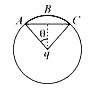
B


The area of cap ABC, `A=2pir^(2)(1-cos theta)`
So flux passing through this area
`phi=2pi r^(2)(1-cos theta) (1)/(4pi in_(0 )) (q)/(r^(2))`
`phi=(q)/(2in_(0))(1-cos theta)`
Promotional Banner

Similar Questions

Explore conceptually related problems

A spherical shell of radius R has a charge +q units. The electric field due to the shell at a point

A point charge q is placed at a distance d from centre of a uniformly charged conducting spherical shell of radius R and having charge Q as shown. Magnitude of electric field intensity at point P just inside the shell due to charge on shell is

A point charge Q is placed inside a conducting spherical shell of inner radius 3R and outer radius 5R at a distance R from the centre of the shell. The electric potential at the centre of the shell will be

A uniformly charged non-conducting spherical shell is given +q charge and a point charge -q is placed as shown. The electric field lines will be

A conducting shell of radius R carries charge -Q . A point charge +Q is placed at the centre. The electric field E varies with distance r (from the centre of the shell) as

A thin non-conducting hemispherical shell contains a positive charge q on it, which uniformly distributed on the shell. A point P lies on the diameter of shell as show in figure. Then the direction of electric field at the point 'P' is

A point charge q is placed inside a conducting spherical shell of inner radius 2R and outer radius 3R at a distance of R fro the centre of the shell. The electric potential at the centre of shell will (potential at infinity is zero).

A point charge +q is placed at the centre of a conducting spherical shell of inner radius a and outer radius b. Find the charge appearing on the inner and outer surface of the shell.

