Home
Class 12
PHYSICS
Three thin rods of mass m and length a e...

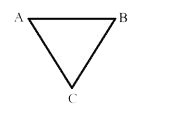
Three thin rods of mass m and length a each are joined to form a triangle ABC in vertical plane. The triangle is pivoted at the vertex A such that it can rotate in the vertical plane. It is released from rest when the side AB is horizontal as shown. As the triangle rotates, the maximum velocity of the vertex B, `v_("MAX")`, is given by:

A

`v_("MAX")^(2)=(4ga)/(sqrt(3))`

B

`v_("MAX")^(2)=sqrt(3)" ga"`

C

`v_("MAX")^(2)=(2ga)/(sqrt(3))`

D

`v_("MAX")^(2)=(ga)/(sqrt(3))`

Text Solution

Verified by Experts

The correct Answer is:

C

Using parallel axis theorem for the side BC, the moment of inertia of the triangle about an axis passing through A and perpendicular to the plane of the triangle,
`I_(A)=2((1)/(3)ma^(2))+((1)/(12)ma^(2)+m((sqrt(3)a)/(2))^(2))=(3)/(2)ma^(2)`
If the angular velocity of the triangle at any instant is `omega`, the velocity of the vertex B at that instant is `a omega`
Therefore, the velocity of B is maximum at the instant the angular velocity is maximum, i.e. when the side BC becomes horizontal
Let the angular velocity at this instant be `omega_("MAX")`
Then, by conservation of energy
Gain in kinetic energy = Loss in potential energy
`(1)/(2)I_(A)omega_("MAX")^(2)=3mg` (Loss in height of CM of triangle)
`(1)/(2)((3)/(2)ma^(2))omega_("MAX")^(2)=3mg((a)/(sqrt(3))-(a)/(2sqrt(3)))=(sqrt(3))/(2)mga" "implies" "omega_("MAX")^(2)=(2g)/(sqrt(3)a)`
Therefore, the maximum velocity of the vertex B is given by `v_("MAX")^(2)=omega_("MAX")^(2)a^(2)=(2ga)/(sqrt(3))`
Promotional Banner

Similar Questions

Explore conceptually related problems

Three identical rods, each of mass m and length l , form an equaliteral triangle. Moment of inertia about one of the sides is

A rod is released from the horizontal position as shown. It is free to rotate about hinge. Find angular velocity of rod when it become vertical?

A uniform rod of mass m and length l is fixed from Point A , which is at a distance l//4 from one end as shown in the figure. The rod is free to rotate in a vertical plane. The rod is released from the horizontal position. What is the reaction at the hinge, when kinetic energy of the rod is maximum?

A uniform rod of mass m and length l can rotate in a vertical plane abota smooth horizontal axis hinged at point H . Find the force exerted by the hinge just after rod is released from rest, from initial horizontal position?

A uniform rod of mass M and length L with two particles m and m_(2) attached to its ends, is pivoted at its centre. The system rotates in a vertical plane with angular velocity omega .

ABC is a triangular framwork of three uniform rods each of mass m and length 2l . It is free to rotate in its own plane about a smooth horizontal axis through A which is perpendicular to ABC. If it is released from rest when AB is horizontal and C is above AB. Find the maximum velocity of C in the subsequent motion.

A slender uniform rod of mass M and length l is pivoted at one ens so that it can rotate in a vertical plane, Fig. There is negligible friction at the pivot. The free end is held vertically above the pivot and then released. The angular acceleration of the rod when it makes an angle theta with the vertical is

A uniform rod of mass m and length l can rotate in vertical plane about a smooth horizontal axis hinged at point H . Find angular acceleration alpha of the rod just after it is released from initial position making an angle of 37^@ with horizontal from rest?

Three idential rods, each of length L , are joined to from a rigid equilateral triangle. Its radius of gtration about an axis passing thorugh a corner and perpendicular to plane of triangle is
