Home
Class 12
PHYSICS
Two fixed long parallel horizontal rails...

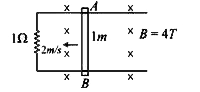
Two fixed long parallel horizontal rails, a distance 1 m apart are joined at one end by a resistance `1Omega`. A rod AB of negligible resistance slides towards the resistance. A magnetic field of magnitude 4T perpendicular to the plane of rails exists. Find the current flowing (in Ampere) in the resistance, at an instant when the velocity of the rod is 2 m/s.

Text Solution

Verified by Experts

The correct Answer is:

8

EMF induced `=BLV=4xx2xx1=8V`
Current produced `=(BLV)/( R )=(8)/(1)=8A`
Promotional Banner

Similar Questions

Explore conceptually related problems

Two thick rods AB, CD are placed parallel to each other at a distance l . their ends are joined to a resistance R . A magnetic field of induction B is applied perpendicular to the plane contaning the rods. If the rods are vertical, the terminal uniform velocity of the rod PQ of mass m is given by

Two long parallel horizontal rails a, a distance d aprt and each having a risistance lambda per unit length are joing at one end by a resistance R. A perfectly conduction rod MN of mass m is free to slide along the rails without friction (see figure). There is a uniform magnetic field of induction B normal to the plane of the paper and directed into the paper. A variable force F is applied to the rod MN such that, as the rod moves a constant current flows through R. (i) Find the velocity of the rod and the applied force F as function of the distance x of the rod from R. (ii) What fraction of the work done per second by F is converted into heat?

A copper rod of mass m slides under gravity on two smooth parallel rails l distance apart set at an angle theta to the horizontal. At the bottom, the rails are joined by a resistance R . There is a uniform magnetic field perpendicular to the plane of the rails. the terminal valocity of the rod is

A vertical ring of radius r and resistance on R falls vertically. It is in contact with two vertical rails which are joined at the top. The rails are without friction and resistance. There is a horizontal uniform, magnetic field of magnitude B perpendicular to the plane of the ring and the rails. When the speed of the ring is v , the current in the section PQ is

A conductor rod AB of mass m slides without friction over two long conducting rails separated by a distance (Fig) At the left end the raidls are interconnected by a resistance R . The system is located in a unifrom magnetic fileld perpendicular to the plane of the loop. At the moment t = 0 the rod AB starts moving to the right with an initial velocity v_(0) . Neglecting the resistances of the rails and the rod AB , as wellas the self -indcuctance, find: (a) the distance covered by the rod until it comes to a standsill, (b) the amount of heat generated in the resitance R during this process.

Figure shows a wire of resistance R sliding on two parallel, conducting fixed thick rails placed at a separation l. A magnetic fild B exist in a direction perpendicular to the plane of the rails. The wire is moving with a constant velocity v. Find current through the wire

Consider the situation shown in the figure. The wire PQ has mass m , resistance r and can slide 0n the smooth, horizontal parallel rails separated by a distance l . The resistance of the rais is negiligible. A uniform magnetic field B exists in the reactangular region and a resistance R connects the rail outside the field region. At t=0 , the wire PQ is pushed toward right with a speed v_(0) . Find (a) the current in the loop at an instant when the speed of the wire PQ is v (b) the acceleration of the wire as this instant (c) the velocity v as a function of x (d) the maximum distance the wire will move (e) the velocity as a function of time

A conducting rod MN of mass m and length 'l' is placed on parallel smooth conducting rails connected to an uncharged capacitor of capacitance C and a battery of emf epsilon as shown. A uniform magnetic field B is existing perpendicular to the plane of the rails. The steady state velocity acquired by the conducting rod MN after closing switch S is (neglect the resistance of the parallel rails and the conducting rod)
