Home
Class 11
PHYSICS
Discuss the forces acting on the n parti...

Discuss the forces acting on the n particles in a system.

Text Solution

Verified by Experts

The force acting on centre of mass,
`MvecA=vec(F_(1))+vec(F_(2))+...vec(F_(n))" here "vec(F_(1))` is not only one force but it is vector sum of forces acting only a particle.
Similarly for second, third, … .n. particle the vector sum of force actin are `vec(F_(2))+vec(F_(3))+...vec(F_(n))`
The forces acting on particles of a system are of two types :
(i) Internal forces due to mutual interactions among the particles and
(ii) External forces
In the figure (a) a system made of particle-1 and particle-2 is shown.
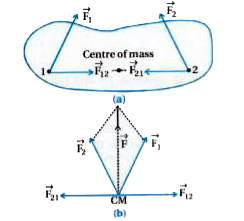
External forces acting on particles 1 and 2 are `vec(F_(1))andvec(F_(2))` respectively and mutual forces interaction are denoted by `vec(F_(12)) and vec(F_(21))`.
Here, all the forces may be considered as acting on the centre of mass which is shown in figure (b).
According to Newton.s third law of motion the internal forces being equal and opposite their resultant is zero. So the force `vecF` acting on the centre of mass can be regarded as resultant external forces only.
`therefore MvecA=vec(F)_(ext)` where `vec(F)_(ext)-vecF` is the resultant force of only external forces.
This equation indicates that the system moves under the effect of resultant external force as if the whole mass of the system where concentrated as its centre of mass.

Promotional Banner

Topper's Solved these Questions

  • SYSTEMS OF PARTICLES AND ROTATIONAL MOTION

    KUMAR PRAKASHAN|Exercise SECTION-A HOTS|3 Videos
  • SYSTEMS OF PARTICLES AND ROTATIONAL MOTION

    KUMAR PRAKASHAN|Exercise SECTION-A (TRY YOURSELF (VSQs))|94 Videos
  • QUESTIONS ASKED IN JEE - 2020

    KUMAR PRAKASHAN|Exercise Question|16 Videos
  • THERMAL PROPERTIES OF MATTER

    KUMAR PRAKASHAN|Exercise Question Paper (Section - D) (Answer following in brief :) Each carry 4 marks|1 Videos

Similar Questions

Explore conceptually related problems

Figure shows the displacement of a particle going along the X-axis as a function of time. The force acting on the particle is zero in the region

Two particles of masses 1.0 kg and 2.0 kg are placed at a separation of 50 cm. Assuming that the only forces acting on the particles are their mutual gravitation find the initial acceleration of the two particles.

If vecF is the force acting on a particle having position vector vecr and vectau be the torque of this force about the region, then :

The momentum of a moving particle given by p=tl nt . Net force acting on this particle is defined by equation F=(dp)/(dt) . The net force acting on the particle is zero at time

A particle of mass m is tied to light string and rotated with a speed v along a circular path of radius r. If T=tension in the string and mg= gravitational force on the particle then actual forces acting on the particle are

The linear momentum of a particle at time t is given by the equation P = x + yt^(2) , where x and y are constants. The instantaneous force acting on the particle during its motion is .....

If the external force acting on a system of particle is zero then …………..

Why does the internal forces acting on the centre of mass of the system be neglected?

Which types of force acting on the system of particle?

The amlitude of a particle executes SHM is 2 cm and the force acting at extreme position on particle is 4N, then what is force at midway between mean position and extreme point?
