Home
Class 11
PHYSICS
Explain the conservation of linear momen...

Explain the conservation of linear momentum for the radioactive decay of radium nucleus.

Text Solution

Verified by Experts
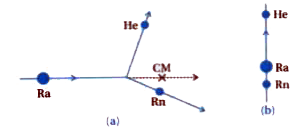
A radium nucleus disintegrates into a nucleus of radon and an `alpha`-particle. The forces leading to the decay are internal to the system and the external forces on the system are negligible.
The total linear momentum of the system is the same before and after decay, according to law of conservation of linear momentum.
For this, the radon nucleus and the `alpha`-particle, move in different directions along the same path along which the original decaying radium nucleus was moving it is shown in figure (a).
If we observe decay of the nucleus from the frame of reference whose centre of mass is at rest, the produced particles move near and opposite to each other such that their centre of mass is at rest. It is shown in figure (b).

In many problems on the system of particles as in the above radioactive decay problem, it is convenient to work in the centre of mass frame rather than in the laboratory frame of reference.
Promotional Banner

Topper's Solved these Questions

  • SYSTEMS OF PARTICLES AND ROTATIONAL MOTION

    KUMAR PRAKASHAN|Exercise SECTION-A HOTS|3 Videos
  • SYSTEMS OF PARTICLES AND ROTATIONAL MOTION

    KUMAR PRAKASHAN|Exercise SECTION-A (TRY YOURSELF (VSQs))|94 Videos
  • QUESTIONS ASKED IN JEE - 2020

    KUMAR PRAKASHAN|Exercise Question|16 Videos
  • THERMAL PROPERTIES OF MATTER

    KUMAR PRAKASHAN|Exercise Question Paper (Section - D) (Answer following in brief :) Each carry 4 marks|1 Videos

Similar Questions

Explore conceptually related problems

Write the law of conservation of linear momentum.

Explain conservation of linear momentum by suitable example.

Explain in-situ conservation in detail

Write the law of conservation of total linear momentum for the system of particle.

Write the law of conservation of angular momentum.

Find dimensional formula of linear momentum.

Explain Cartesian components of angular momentum of a particle.

