A body may be in partial equilibrium, means it may be in translational equilibrium and not in rotational equilibrium, or it may be in rotational equilibrium are not in translational equilibrium.
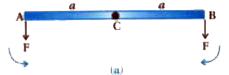
Consider a light rod of negligible mass AB at the its two ends of which two parallel forces both equal in magnitdue are applied perpendicular to the rod as shown in above figure.
C be the midpoint of AB.
`therefore CA=CB=a` assumed.
The moment of the forces at A and B will both be equal in magnitude (aF), but opposite in sense as shown. The net moment on the rod will be zero. The system will be in rotational equilibrium, but it will not be in translational equilibrium : `sum vecFne0`
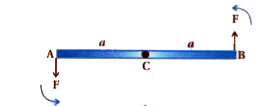
Now consider a light rod of negligible mass and length 2a. Its two ends A and B of which two equal and opposite forces `vecF` applied perpendicuarlto the rod. C be the midpoint of AB.
`therefore AC=BC=a`
Hence, both the torque on the rod in the same direction, cause anti-clockwise rotation of the rod.
So, the total force on the body is zero, so the body is in translational equilibrium, but it is not in rotational equilibrium due to torque.
If rod is fixed at C, then it undergoes pure rotational motion.


