An ideal lever is a light rod of negligible mass pivoted at the point along its length. This point is called the fulcrum. The lever is a system in mechanical equilibrium.
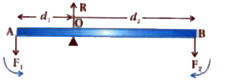
Two forces `vec(F_(1)) and vec(F_(2))` parallel to each other and usually perpendicular to the lever, as shown here, act on the lever at distances `d_(1)andd_(2)` respectively from the fulcrum as shown in fig.
Let `vecR` be the reaction of the support at the fulcrum. `vecR` is directed opposite to the forces `vec(F_(1))` and `vec(F_(2))`.
The forces in upward direction are considered positive and the forces in downward direction are considered negative.
For translational equilibrium
`R-F_(1)-F_(2)=0....(1)`
`therefore R=F_(1)+F_(2)`
The lever force `F_(1)` is some weight to be lifted. It is called the load and its distance from the fulcrum `d_(1)` is called the load arm.
Force `F_(2)` is the effort applied to lift the load, distance `d_(2)` of the effort from the fulcrum is the effort arm.
For rotational equilibrium, sum of torque about a effort point should be zero and moment of force `tau=d xxF[because theta=90^(@), therefore sin90^(@)=1]`
`therefore d_(1)F_(1)-d_(2)F_(2)=0`
Here, the anticlockwise moment is considered as positive and the clockwise moment is considered as negative. So `d_(2)F_(2)` taken with negative.
`therefore d_(1)F_(1)=d_(2)F_(2)`
Means load arm `xx` load = effort arm `xx` effort
The above equation expresses the principle of moment for a lever.
The ratio `(F_(1))/(F_(2))` is called the mechanical advantage [M.A.]
`therefore M.A.=(F_(1))/(F_(2))=(d_(2))/(d_(1)) [because d_(1)F_(1)=d_(2)F_(2)]`
If the effort arm `d_(2)` is larger than the load arm, `[d_(2)gtd_(1)]` the mechanical advantage is greater than one. Means that a small effort can be used to lift a large load.
The principle of moment holds even when the parallel force `vec(F_(1))andvec(F_(2))` are not perpendicular but act at some angle to the lever.


