The point at which the entire weight of a small body mag be considered as concentrated, such a point is known as centre of gravity (CG).
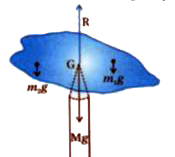
Take an irregular shaped cardboard and a narrow tipped object like a pencial. Locate point G on the cardboard where it can be balanced on the tip of the pencil. The point of balance is the centre of gravity (CG) of the cardboad.
The tip of the pencil provides a vertically upward force due to which the cardboard is in mechanical equilibrium. The reaction of the tip is equal and opposite to (Mg), the total weight of cardboard and hence the cardboard is in translational equilibrium.
There are torques on the cardboard due to the force of gravity. If the total torque on it due to the downward forces is zero, then cardboard remain in rotational equilibrium.
If `m_(i)` is the masses of different particles of the cardboard and `vec(r_(i))` is the position vector of the `i^(th)` particle, then force of gravity on the particle is `vec(tau_(i))=vec(r_(i))xxvec(mg)`
The total gravitational torque on the body is zero.
`therefore vec(tau_(g))=sumvec(tau_(i))=vec0`
`=sumx_(i)m_(i)g=vec0`
Hence cardboard remains in rotational equilibrium.


