Home
Class 11
PHYSICS
State and prove theorem of parallel axis...

State and prove theorem of parallel axis.

Text Solution

Verified by Experts
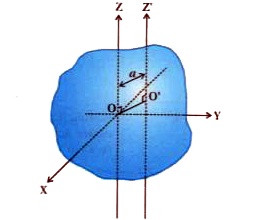
The moment of inertia of a body about any axis is equal to the sum of the moment of inertia of the body about a parallel axis passing through its centre of mass and the product of its mass and the square of the distance between the two parallel axes.

As shown in figure Z and Z. are two parallel axes separated by a distance a. `therefore OO.=a`
The Z-axis passes through the centre of mass O of the rigid body.
From theorem of parallel axes
`I_(Z)=I_(Z)+Ma^(2)orI_(Z)=I_(C)+M(OO.)^(2)`
where `I_(Z)andI_(Z)` are the moments of inertia of the body about the Z and Z. axes respectively.
M = total mass of the body
a = perpendicular distance between the two parallel axes.
If moment of inertia of object of any shape about the axis passing through its centre is given, then moment of inertia about the axis parallel to the axis passing through its centre can be determined.
Promotional Banner

Topper's Solved these Questions

  • SYSTEMS OF PARTICLES AND ROTATIONAL MOTION

    KUMAR PRAKASHAN|Exercise SECTION-A HOTS|3 Videos
  • SYSTEMS OF PARTICLES AND ROTATIONAL MOTION

    KUMAR PRAKASHAN|Exercise SECTION-A (TRY YOURSELF (VSQs))|94 Videos
  • QUESTIONS ASKED IN JEE - 2020

    KUMAR PRAKASHAN|Exercise Question|16 Videos
  • THERMAL PROPERTIES OF MATTER

    KUMAR PRAKASHAN|Exercise Question Paper (Section - D) (Answer following in brief :) Each carry 4 marks|1 Videos

Similar Questions

Explore conceptually related problems

State and prove theorem of perpendicular axes.

(a) Prove the theorem of perpendicular axes. (Hint : Square of the distance of a point (x, y) in the x-y plane from an axis through the origin perpendicular to the plane is x^(2)+y^(2) ). (b) Prove the theorem of parallel axes. (Hint : If the centre of mass is chosen to be the origin Sigmam_(1)(r_(i)=0) .

Write carnot theorem.

State and prove Pascal's law.

The tangent at a point P of a curve meets the y-axis at A, and the line parallel to y-axis through P meets the x-axis at B. If area of DeltaOAB is constant (O being the origin), Then the curve is

Prove that the force acting on one plate due to the other in a parallel plate capacitor is F =(1)/(2) (CV^(2))/(d) .

State the merits and demerits of a parallel combination of resistors.

If a transversal intersects two lines such that the bisectors of a pair of corresponding angles are parallel, then prove that the two lines are parallel.

Prove that two triangles on the same base and between the same parallels are equal in area.

