Suppose a rigid body rotating about a fixed axis, which is taken as the Z-axis. This axis is perpendicular to plane X.Y..
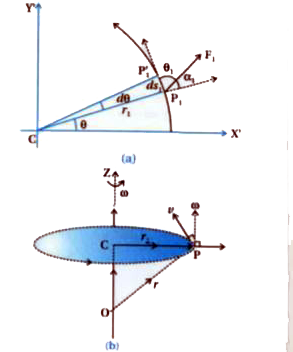
Let force `vec(F_(1))` acting on a particle of the body at point `P_(1)` and it rotates on a circle of radius `r_(1)` with centre C on the axis `CP_(1)=r_(1)`.
In time `Deltat`, the point moves to the position `P._(1)` from `P_(1)`. The displacement of the particle is `DeltaS_(1)=r_(1)Deltatheta` and it is in the direction tangential at `P_(1)therefore Deltatheta=angleP_(1)OP._(1)` is the angular displacement of the particle. The work done by the force `vec(F_(1))` on the particle is
`dW_(1)=vec(F_(1)).dvec(S_(1))`
`=F_(1)DeltaS_(1)cosphi_(1)`
`=F_(1)r_(1)Deltathetacos(90^(@)-alpha_(1))`
where `DeltaS_(1)=r_(1)Delta thetaand phi_(1)+alpha_(1)=90^(@)`
where `phi_(1)` is the angle between `vec(F_(1))` and the tangent at `P_(1) and alpha_(1)` is the angle between `vec(F_(1))` and the radius vector `vec(OP)=vec(r_(1)), phi`
The torque due to `vec(F_(1))` about the origin
`vectau=vec(OP_(1))xxvec(F_(1))" "....(1)`
but according to figure (b)
`vec(OP)_(1)=vec(OC)+vec(CP)_(1)`
Since `vec(OP)` is along the axis,
`therefore tau=OC(F_(1))sin0^(@)=0`, hence `vec(OP)_(1)=vec(CP)_(1)`
From eqn. (1),
`vec(tau_(1))=vec(CP)_(1)xxvec(F_(1))`
`therefore vec(tau_(1))=vec(r_(1))xxvec(F_(1))[because vec(CP_(1))=vec(r_(1))]`
`therefore tau_(1)=r_(1)F_(1)sinalpha_(1)`
and work `DeltaW_(1)=tau_(1)Deltatheta`
If there are more than one forces acting on the body the work done by all of them can be added to give the total work done on the body
`DeltaW=(tau_(1)+tau_(2)+tau_(3)+....tau_(n))Deltatheta`
`therefore DeltaW=tauDeltatheta" "....(2)`
where `tau_(1)+tau_(2)+tau_(3)+....tau_(n)=tau` total torque
If `Deltathetararr0` total work done,
`dW=taud theta` is similar to eqn.
`dW=Fds` in linear motion
Diving (2) on both in eqn. (2)
`(DeltaW)/(Deltat)=tau.(Deltatheta)/(Deltat)`
If `Deltatrarr0=(DeltaW)/(Deltat)=(dW)/(dt)and(Deltatheta)/(Deltat)=(d theta)/(dt)`
`therefore` Instantaneous power,
`P=tau.(d theta)/(dt)`
`therefore P=tauomega`
This is the instantaneous power. It is similar to equation `P=Fv` in linear motion.


