Home
Class 11
PHYSICS
Explain the torque acting on a rigid bod...

Explain the torque acting on a rigid body.

Text Solution

Verified by Experts

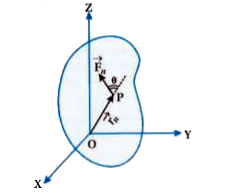
As shown in the figure a rigid body rotates about a fixed axis OZ.
`vec(F_(1)),vec(F_(2))….vec(F_(n))` are the forces acting on the particles with position vectors `vec(r_(1)),vec(r_(2)),vec(r_(3))…..vec(r_(n))`. Respectively.
The force `vec(F)_(n)` is acting on the particle with position vector `vec(r_(n))`. The torque on it is given by,
`vec(tau_(n))=vec(r_(n))xxvec(F)_(n)`
`=|(hati,hatj,hatk),(x_(n),y_(n),z_(n)),(F_(nx),F_(ny),F_(nz))|`
`therefore vectau=hati[y_(n)F_(nz)-Z_(n)F_(ny)]+hatj[Z_(n)F_(nx)-x_(n)F_(nz)]+hatk[x_(n)F_(ny)-y_(n)F_(nx)]....(1)`
The torque acting on the rigid body can be obtained by taking the vector sum of such torques.
`therefore vectau=underset(n)sumhati[y_(n)F_(nz)-Z_(n)F_(ny)]+hatj[Z_(n)F_(nx)-x_(n)F_(nz)]+hatk[x_(n)F_(ny)-y_(n)F_(nx)]`
The Z component of this torque is responsible for the torsional motion of the rigid body about Z-axis. Similarly X and Y components of torque are responsible for the motion about X and Y axis respectively.
In general if rotational motion is about a fixed axis with `hatn` as the unit vector on it, the component of the torque responsible for rotational motion is `vectau.hatn`.
In the rotational motion of a rigid body it is not necessary to apply forces on all the particles of the body.
Since the relative positions of the particles of a rigid body are invariant, a torque appliedon any particle can be considered to be the torque on the entire body. So if `vecF` is a force on a particle and `vecr` is the position vector of the particle the torque on the body can be taken as. `vectau=vecrxxvecF`
Promotional Banner

Topper's Solved these Questions

  • SYSTEMS OF PARTICLES AND ROTATIONAL MOTION

    KUMAR PRAKASHAN|Exercise SECTION-A (TRY YOURSELF (VSQs))|94 Videos
  • SYSTEMS OF PARTICLES AND ROTATIONAL MOTION

    KUMAR PRAKASHAN|Exercise SECTION-B NUMERICALS|29 Videos
  • SYSTEMS OF PARTICLES AND ROTATIONAL MOTION

    KUMAR PRAKASHAN|Exercise SECTION-F (SECTION-D) QUESTIONS PAPER|1 Videos
  • QUESTIONS ASKED IN JEE - 2020

    KUMAR PRAKASHAN|Exercise Question|16 Videos
  • THERMAL PROPERTIES OF MATTER

    KUMAR PRAKASHAN|Exercise Question Paper (Section - D) (Answer following in brief :) Each carry 4 marks|1 Videos

Similar Questions

Explore conceptually related problems

What is torque? Explain the torque acting on a particle.

The vector sum of a system of non-collinear forces acting on a rigid body is given to be non-zero. If the vector sum of all the torques due to the system of forces about a certain point is found to be zero, does this mean that it is necessarily zero about any arbitrary point?

There are three forces F_(1) F_(2) and F_(3) acting on a body, all acting on a point P on the body. The body is found to move with uniform speed. (a) Show that the forces are coplanar. (b) Show that the torque acting on the body about any point due to these three forces is zero.

Explain the reflection of wave at rigid support.

What is a rigid body ? Explain the differences between rigid body and solid body.

Write the formula of work done by torque in rotational rigid body about a the fixed axis.

Why the components of position vectors along axis are not needed for determining the torque in the rigid body?

When the torque acting on electric dipole in uniform electric field becomes zero ?

What is the torque acting on the centre of mass due to gravitational force ?
