Home
Class 12
PHYSICS
Obtain mirror equation for the real imag...

Obtain mirror equation for the real image obtained by concave mirror.

Text Solution

Verified by Experts
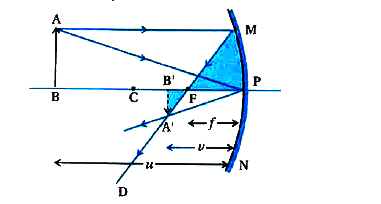

An object AB is perpendicular to principal axis away from C of a concave mirror.
AM ray from point A incidents on mirror at M and reflected ray passes through principal focus F.
AP ray from point A incidents on pole P and reflects back in form of PA.
These both reflected rays intersect at A., hence A. is real image of A.
A.B. is image of object AB due to reflection of rays from mirror.
Let FP = focal length f
CP = radius of curvature R
BP = object distance u
B.P= image distance v
For paraxial rays, MP can be considered to be a straight line perpendicular to CP.
The two right-angled triangles A.B.F and MPF are similar.
`therefore(B.A.)/(PM)=(B.F)/(FP)`
But PM = BA
`therefore (B.A.)/(BA)=(B.F)/(FP)`....(1)
Since `angleAPB = angleA.PB.`, the right angled triangles A.B.P and ABP are also similar. Therefore,
`therefore(B.A.)/(BA)=(B.P)/(BP)` ...(2)
Comparing Equations (1) and (2),
`(B.F)/(FP)=(B.P)/(BP)`
but B.F = B.P - FP
`therefore (B.P-FP)/(FP)=(B.P)/(BP)` ....(3)
Now, according to sign convention, B.P = - v, FP = - f, BP = - u
From equation (3),
`(-v+f)/(-f)=(-v)/(-u)`
`therefore (v-f)/(f)=v/u`
`therefore v/f-1=v/u`
`therefore v/f=1+v/u`
Now,dividing by v,
`therefore 1/f=1/v+1/u`
Which is mirror equation and it is called Gaussian equation as it was given by scientist Gauss.
Promotional Banner

Topper's Solved these Questions

  • RAY OPTICS AND OPTICAL INSTRUMENTS

    KUMAR PRAKASHAN|Exercise SECTION - A (TRY YOURSELF)|74 Videos
  • RAY OPTICS AND OPTICAL INSTRUMENTS

    KUMAR PRAKASHAN|Exercise SECTION-B (NUMERICALS)(NUMERICAL FROM TEXTUAL ILLUSTRATIONS)|17 Videos
  • MOVING CHARGES AND MAGNETISM

    KUMAR PRAKASHAN|Exercise SECTION D (MCQs ASKED IN COMPETITIVE EXAMS)|34 Videos
  • SAMPLE QUESTION PAPER

    KUMAR PRAKASHAN|Exercise PART-B SECTION-C|5 Videos

Similar Questions

Explore conceptually related problems

Write mirror equation for spherical mirror.

Obtain the equation of thin lens.

What is linear magnification ? Obtain equation of linear magnification for concave mirror.

Use the mirror equation to deduce that: (a) an object placed between f and 2f of a concave mirror produces a real image beyond 2f. (b) a convex mirror always produces a virtual image independent of the location of the object. (c) the virtual image produced by a convex mirror is always diminished in size and is located between the focus and the pole. (d) an object placed between the pole and focus of a concave mirror produces a virtual and enlarged image.

Explain the ray diagram for image obtained for concave mirror by considering three rays.

Use the mirror equation to deduce that: (a) An object placed between f and 2f of a concave mirror produces a real image beyond 2f. (b) A convex mirror always produce a virtual image independent of the location of the object. ( c) The virtual image produced by a convex mirror is always diminished in size and it located between the focus and the pole.

A balloon is rising up along the axis of a concave mirror of radius of curvature 20 m A ball is dropped from the balloon at a height 15m from the mirror when the balloon has velocity 20m//s .Find the speed of the image of the ball formed by concave mirror after 4 seconds[take: g=10m//s^(2) ]

If x and y denote the distance of the object and image from the focus of a concave mirror . The line y=4x cuts the graph at a point whose abscissa is 20 cm. The focal length of the mirror is

Give definition of focal plane for concave mirror.

KUMAR PRAKASHAN-RAY OPTICS AND OPTICAL INSTRUMENTS-SECTION-D (MULTIPLE CHOICE QUESTIONS (MCQs))(MCQs ASKED IN COMPETITIVE EXAMS)
  1. Obtain mirror equation for the real image obtained by concave mirror.

    Text Solution

    |

  2. Which of the following is used in optical fibres ?

    Text Solution

    |

  3. An astronomical telescope has a large aperture to ….. .

    Text Solution

    |

  4. If two mirrors are kept at 60^@ to each other, then the number of imag...

    Text Solution

    |

  5. As shown in figure, a plano-convex lens of focal length 20 cm is silve...

    Text Solution

    |

  6. A light ray is incident perpendicular to one face of a 90^@ prism and ...

    Text Solution

    |

  7. A plano- convex lens of refractive index 1.5 and radius of curvature 3...

    Text Solution

    |

  8. The refractive index of transparent cylindrical rod is (2)/(root3) . A...

    Text Solution

    |

  9. A fish looking up through the water sees the outside world, contained ...

    Text Solution

    |

  10. Two point white dots are 1 mm apart on a black paper. They are viewed ...

    Text Solution

    |

  11. A thin glass (refractive index 1.5) lens has optical power of - 5D in ...

    Text Solution

    |

  12. The refractive index of glass is 1.520 for red light and 1.525 for blu...

    Text Solution

    |

  13. Two lenses of power - 15D and + 5D are in contact with each other. The...

    Text Solution

    |

  14. When monochromatic red light is used instead of blue light in a convex...

    Text Solution

    |

  15. A beaker contains water up to a height h(1) and kerosene of height h(2...

    Text Solution

    |

  16. Diameter of a plano-convex lens is 6 cm and thickness at the centre is...

    Text Solution

    |

  17. A green light is incident from the water to the air-water interface at...

    Text Solution

    |

  18. Monochromatic light is incident on a glass prism of angle A. If the re...

    Text Solution

    |

  19. On a hot summer night, the refractive index of air is smallest near th...

    Text Solution

    |

  20. An observer looks at a distant tree of height 10 m with a telescope of...

    Text Solution

    |

  21. A diverging lens with magnitude of focal length 25 cm is placed at a d...

    Text Solution

    |

