Home
Class 12
PHYSICS
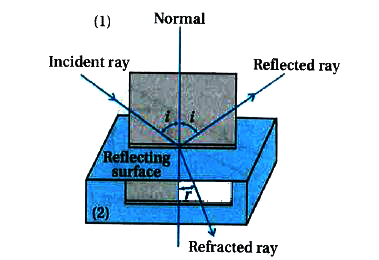
Only draw a figure which explains the re...

Only draw a figure which explains the reflection and refraction of light.

Text Solution

Verified by Experts
Promotional Banner

Topper's Solved these Questions

  • RAY OPTICS AND OPTICAL INSTRUMENTS

    KUMAR PRAKASHAN|Exercise SECTION - A (TRY YOURSELF)|74 Videos
  • RAY OPTICS AND OPTICAL INSTRUMENTS

    KUMAR PRAKASHAN|Exercise SECTION-B (NUMERICALS)(NUMERICAL FROM TEXTUAL ILLUSTRATIONS)|17 Videos
  • MOVING CHARGES AND MAGNETISM

    KUMAR PRAKASHAN|Exercise SECTION D (MCQs ASKED IN COMPETITIVE EXAMS)|34 Videos
  • SAMPLE QUESTION PAPER

    KUMAR PRAKASHAN|Exercise PART-B SECTION-C|5 Videos

Similar Questions

Explore conceptually related problems

Explain reflection and refraction of waves.

Explain the reflection of wave at free support.

Explain the reflection of wave at rigid support.

A ray light of intensity I is incident on a parallel glass-slab at a point A as shown in figure it undergoes partial reflection and refraction. At each reflection 25% of incident energy is refracted rays AB and A'B' undergo interference find the ratio I_(max)//I_(min)

Explain the reflection of plane wavefront from concave mirror.

Explain internal reflection and total internal reflection.

(a) When monochromatic light is incident on a surface separating two media, the reflected and refracted light both have the same frequency as the incident frequency. Explain why? (b) When light travels from a rarer to a denser medium, the speed decreases. Does the reduction in speed imply a reduction in the energy carried by the light wave? (c) In the wave picture of light, intensity of light is determined by the square of the amplitude of the wave. What determines the intensity of light in the photon picture of light

A ray of light from a denser medium strike a rarer medium at an angle of incidence I (see Fig). The reflected and refracted rays make as angle of 90degrees with each other. The angles of reflection and refraction are r and r The critical angle is

Huygen was the figure scientist who proposed the idea of wave theory of light he said that the light propagates in form of wavelengths. A wavefront is a imaginary surface of every point of which waves are in the same. phase. For example the wavefront for a point source of light is collection of concentric spheres which have centre at the origin w_(1) is a wavefront w_(2) is another wavefront. The radius of the wavefront at time 't' is 'ct' in thic case where 'c' is the speed of light the direction of propagation of light is perpendicular to the surface of the wavelength. the wavefronts are plane wavefronts in case of a parallel beam of light. Huygen also said that every point of the wavefront acts as the source of secondary wavelets. The tangent drawn to all secondary wavelets at a time is the new wavefront at that time. The wavelets are to be considered only in the forward direction (i.e., the direction of propagation of light) and not in the reverse direction if a wavefront w_(1) and draw spheres of radius 'cDeltat' they are called secondary wavelets. Draw a surface w_(2) which is tangential to all these secondary wavelets w_(2) is the wavefront at time t+Deltat Huygen proved the laws of reflection and laws of refraction using concept of wavefront. Q. Spherical wavefronts shown in figure, strike a plane mirror. reflected wavefront will be as shown in

KUMAR PRAKASHAN-RAY OPTICS AND OPTICAL INSTRUMENTS-SECTION-D (MULTIPLE CHOICE QUESTIONS (MCQs))(MCQs ASKED IN COMPETITIVE EXAMS)
  1. Only draw a figure which explains the reflection and refraction of lig...

    Text Solution

    |

  2. Which of the following is used in optical fibres ?

    Text Solution

    |

  3. An astronomical telescope has a large aperture to ….. .

    Text Solution

    |

  4. If two mirrors are kept at 60^@ to each other, then the number of imag...

    Text Solution

    |

  5. As shown in figure, a plano-convex lens of focal length 20 cm is silve...

    Text Solution

    |

  6. A light ray is incident perpendicular to one face of a 90^@ prism and ...

    Text Solution

    |

  7. A plano- convex lens of refractive index 1.5 and radius of curvature 3...

    Text Solution

    |

  8. The refractive index of transparent cylindrical rod is (2)/(root3) . A...

    Text Solution

    |

  9. A fish looking up through the water sees the outside world, contained ...

    Text Solution

    |

  10. Two point white dots are 1 mm apart on a black paper. They are viewed ...

    Text Solution

    |

  11. A thin glass (refractive index 1.5) lens has optical power of - 5D in ...

    Text Solution

    |

  12. The refractive index of glass is 1.520 for red light and 1.525 for blu...

    Text Solution

    |

  13. Two lenses of power - 15D and + 5D are in contact with each other. The...

    Text Solution

    |

  14. When monochromatic red light is used instead of blue light in a convex...

    Text Solution

    |

  15. A beaker contains water up to a height h(1) and kerosene of height h(2...

    Text Solution

    |

  16. Diameter of a plano-convex lens is 6 cm and thickness at the centre is...

    Text Solution

    |

  17. A green light is incident from the water to the air-water interface at...

    Text Solution

    |

  18. Monochromatic light is incident on a glass prism of angle A. If the re...

    Text Solution

    |

  19. On a hot summer night, the refractive index of air is smallest near th...

    Text Solution

    |

  20. An observer looks at a distant tree of height 10 m with a telescope of...

    Text Solution

    |

  21. A diverging lens with magnitude of focal length 25 cm is placed at a d...

    Text Solution

    |

