Home
Class 12
PHYSICS
Explain internal reflection and total in...

Explain internal reflection and total internal reflection.

Text Solution

Verified by Experts
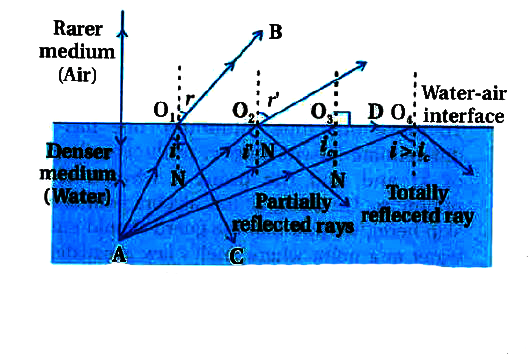
When light travels from an optically denser medium to a rarer medium at the interface, it is partly reflected back into the same medium and partly refracted to the second medium. This reflection is called the internal reflection.
When a ray of light enters from a denser medium to a rarer medium it bends away from the normal.

The ray `AO_1B` in figure the incident ray `AO_1`, is partially reflected `(O_1C)` and partially transmitted `(O_1B)` or refracted.
The angle of refraction (r) being larger than the angle of incidence (i).
As the angle of incidence increases, so does the angle of refraction, till for the ray `AO_3`, the angle of refraction is `pi/2`
The refracted ray is bent so much away from the normal that it grazes the surface at the interface between the two media. This is shown by the ray `AO_3D`.
The angle of incidence for which the refraction angle becomes `pi/2`, that incidence angle is called critical angle `.i_C.`.
The deviated ray obtained after incidence at critical angle is called critical ray.
If the angle of incidence is increased still further e.g. the ray `AO_4`, refraction is not possible and the incident ray is totally reflected. This is called total internal reflection,
When light gets reflected by a surface, normal some fraction of it gets transmitted. The reflected ray, therefore, is always less inten: than the incident ray, howsoever smooth th reflecting surface may be. In total intern reflection on the other hand, no transmission light takes place.
According to Snell.s law at point `O_3`,
`nisin i_c = n_2 sin r`
`therefore (n_1)/(n_2)sin i_c = sin" "r`
`therefore n_(12) sin i_c = sin 90^@" " [because r = 90^@]`
`therefore n_(12)sin i_c = 1`
`therefore _(12) = (1)/(sin i_c)` (where `n_(12)` = refractive inde of denser medium-1 w.r.t. rarer medium-2)
If `n_1 = n` and `n_2` = 1 (air) then, sin `i_c` = 1
`therefore n=(1)/(sin i_c)`
Promotional Banner

Topper's Solved these Questions

  • RAY OPTICS AND OPTICAL INSTRUMENTS

    KUMAR PRAKASHAN|Exercise SECTION - A (TRY YOURSELF)|74 Videos
  • RAY OPTICS AND OPTICAL INSTRUMENTS

    KUMAR PRAKASHAN|Exercise SECTION-B (NUMERICALS)(NUMERICAL FROM TEXTUAL ILLUSTRATIONS)|17 Videos
  • MOVING CHARGES AND MAGNETISM

    KUMAR PRAKASHAN|Exercise SECTION D (MCQs ASKED IN COMPETITIVE EXAMS)|34 Videos
  • SAMPLE QUESTION PAPER

    KUMAR PRAKASHAN|Exercise PART-B SECTION-C|5 Videos

Similar Questions

Explore conceptually related problems

What is total internal reflection ?

Write condition for total internal reflection.

A cubical block of glass of refractive index n_1 is in contact with the surface of water of refractive index n_2. A beam of light is incident on vertical face of the block. After refraction a total internal reflection at the base and refraction at the opposite face take place. The ray emerges at angle theta as shown. The value of theta is given by

Explain the phenomena of total internal reflection in right angle prism.

Explain experiment which represents the total internal reflection.

External fertilization and Internal fertilization.

Assertion : The images formed by total internal reflections are much brighter than those formed by mirrorrs or lenses. Reason : There is no loss of intensity in total internal reflection.

A ray of light enters in denser medium from rarer medium. Speed of light in rarer medium is double than that in denser medium, what is the critical angle for total internal reflection ?

The figure shows the path of a ray passing through an equiangular prism PQR. It is incident on face PR at angle slightly greater than the critical angle for total internal reflection . If the angle alpha shown in the figure is 30^(@) . Calculate the R.I. of the material of the prism.

When light ray travels from ...... then total internal reflection is possible.

KUMAR PRAKASHAN-RAY OPTICS AND OPTICAL INSTRUMENTS-SECTION-D (MULTIPLE CHOICE QUESTIONS (MCQs))(MCQs ASKED IN COMPETITIVE EXAMS)
  1. Explain internal reflection and total internal reflection.

    Text Solution

    |

  2. Which of the following is used in optical fibres ?

    Text Solution

    |

  3. An astronomical telescope has a large aperture to ….. .

    Text Solution

    |

  4. If two mirrors are kept at 60^@ to each other, then the number of imag...

    Text Solution

    |

  5. As shown in figure, a plano-convex lens of focal length 20 cm is silve...

    Text Solution

    |

  6. A light ray is incident perpendicular to one face of a 90^@ prism and ...

    Text Solution

    |

  7. A plano- convex lens of refractive index 1.5 and radius of curvature 3...

    Text Solution

    |

  8. The refractive index of transparent cylindrical rod is (2)/(root3) . A...

    Text Solution

    |

  9. A fish looking up through the water sees the outside world, contained ...

    Text Solution

    |

  10. Two point white dots are 1 mm apart on a black paper. They are viewed ...

    Text Solution

    |

  11. A thin glass (refractive index 1.5) lens has optical power of - 5D in ...

    Text Solution

    |

  12. The refractive index of glass is 1.520 for red light and 1.525 for blu...

    Text Solution

    |

  13. Two lenses of power - 15D and + 5D are in contact with each other. The...

    Text Solution

    |

  14. When monochromatic red light is used instead of blue light in a convex...

    Text Solution

    |

  15. A beaker contains water up to a height h(1) and kerosene of height h(2...

    Text Solution

    |

  16. Diameter of a plano-convex lens is 6 cm and thickness at the centre is...

    Text Solution

    |

  17. A green light is incident from the water to the air-water interface at...

    Text Solution

    |

  18. Monochromatic light is incident on a glass prism of angle A. If the re...

    Text Solution

    |

  19. On a hot summer night, the refractive index of air is smallest near th...

    Text Solution

    |

  20. An observer looks at a distant tree of height 10 m with a telescope of...

    Text Solution

    |

  21. A diverging lens with magnitude of focal length 25 cm is placed at a d...

    Text Solution

    |

