Home
Class 12
PHYSICS
Obtain the equivalent focal length of co...

Obtain the equivalent focal length of combination of thin lenses placed in contact,

Text Solution

Verified by Experts
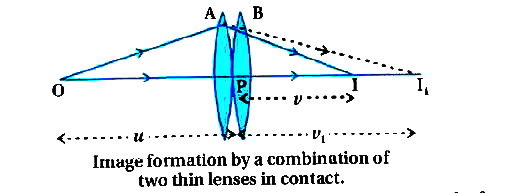

Consider two lenses A and B of focal length `f_1` and `f_2`, placed in contact with each other.
Let the object be placed at a point 0 beyond the focus of the first lens A.
The first lens produces an image at `I_1`,. Since image `I_1`, is real, it serves as a virtual object for the second lens B producing the final image at I.
Formation of image by the first lens is presumed only to facilitate determination of the position of the final image. In fact, the direction of rays emerging from the first lens gets modified in accordance with the angle at which they strike the second lens.
Since the lenses are thin, we assume the optical centres of the lenses to be coincident. Let this central point be denoted by P.
For the image formed by the first lens A,
`(1)/(v_1)-(1)/(u)=(1)/(f_1)` ... (1)
For the image formed by the second lens B,
`1/v-(1)/(v_1)=(1)/(f_2)` ... (2)
Adding equation (1) and (2),
`1/v-1/u=(1)/(f_1)+(1)/(f_2)` ... (3)
If the two lens system is regarded as equivalent to a single lens of focal length f we have,
`1/f=(1)/(f_1)+(1)/(f_2)`
The derivation is valid for any number of thin lenses in contact. If several thin lenses of focal length `f_1, f_2, f_3, ...f_n` In are in contact, the effective focal length of their combination is given by,
`1/f=(1)/(f_1)+(1)/(f_2)+(1)/(f_3)+...`
Promotional Banner

Topper's Solved these Questions

  • RAY OPTICS AND OPTICAL INSTRUMENTS

    KUMAR PRAKASHAN|Exercise SECTION - A (TRY YOURSELF)|74 Videos
  • RAY OPTICS AND OPTICAL INSTRUMENTS

    KUMAR PRAKASHAN|Exercise SECTION-B (NUMERICALS)(NUMERICAL FROM TEXTUAL ILLUSTRATIONS)|17 Videos
  • MOVING CHARGES AND MAGNETISM

    KUMAR PRAKASHAN|Exercise SECTION D (MCQs ASKED IN COMPETITIVE EXAMS)|34 Videos
  • SAMPLE QUESTION PAPER

    KUMAR PRAKASHAN|Exercise PART-B SECTION-C|5 Videos

Similar Questions

Explore conceptually related problems

Obtain the equation of magnification of combination of lenses.

Obtain the equation of power for combination of lenses.

Determine the .effective focal length. of the combination of the two lenses in Exercise 9.10, if they are placed 8.0 cm apart with their principal axes coincident. Does the answer depend on which side of the combination a beam of parallel light is incident ? Is the notion of effective focal length of this system useful at all .

Obtain the equation of thin lens.

Given figures show the arrangements of two lenses. The radii of curvature of all the curved surfaces are same. The ratio of the equivalent focal length of combinations P, Q and R is ......

Focal length of thin lens ......

Convex lens having focal length f, and concave lens having focal length f2 are placed in contact. Out of conditions given below, which condition supports this combination to behave like concave lens ?

Two similar thin equi-convex lenses, of focal length f each, are kept coaxially in contact with each other such that the focal length of the combination is F_1 , when the space between the two lenses is filled with glycerin (which has the same refractive index ( mu = 1.5) as that of glass) then the equivalent focal length is F_2 . The ratio F_1 :F_2 will be :

Calculate equivalent focal length of plano convex lens for following case:- (i) When curved surface is silvered. (ii) When plane surface is silvered.

KUMAR PRAKASHAN-RAY OPTICS AND OPTICAL INSTRUMENTS-SECTION-D (MULTIPLE CHOICE QUESTIONS (MCQs))(MCQs ASKED IN COMPETITIVE EXAMS)
  1. Obtain the equivalent focal length of combination of thin lenses place...

    Text Solution

    |

  2. Which of the following is used in optical fibres ?

    Text Solution

    |

  3. An astronomical telescope has a large aperture to ….. .

    Text Solution

    |

  4. If two mirrors are kept at 60^@ to each other, then the number of imag...

    Text Solution

    |

  5. As shown in figure, a plano-convex lens of focal length 20 cm is silve...

    Text Solution

    |

  6. A light ray is incident perpendicular to one face of a 90^@ prism and ...

    Text Solution

    |

  7. A plano- convex lens of refractive index 1.5 and radius of curvature 3...

    Text Solution

    |

  8. The refractive index of transparent cylindrical rod is (2)/(root3) . A...

    Text Solution

    |

  9. A fish looking up through the water sees the outside world, contained ...

    Text Solution

    |

  10. Two point white dots are 1 mm apart on a black paper. They are viewed ...

    Text Solution

    |

  11. A thin glass (refractive index 1.5) lens has optical power of - 5D in ...

    Text Solution

    |

  12. The refractive index of glass is 1.520 for red light and 1.525 for blu...

    Text Solution

    |

  13. Two lenses of power - 15D and + 5D are in contact with each other. The...

    Text Solution

    |

  14. When monochromatic red light is used instead of blue light in a convex...

    Text Solution

    |

  15. A beaker contains water up to a height h(1) and kerosene of height h(2...

    Text Solution

    |

  16. Diameter of a plano-convex lens is 6 cm and thickness at the centre is...

    Text Solution

    |

  17. A green light is incident from the water to the air-water interface at...

    Text Solution

    |

  18. Monochromatic light is incident on a glass prism of angle A. If the re...

    Text Solution

    |

  19. On a hot summer night, the refractive index of air is smallest near th...

    Text Solution

    |

  20. An observer looks at a distant tree of height 10 m with a telescope of...

    Text Solution

    |

  21. A diverging lens with magnitude of focal length 25 cm is placed at a d...

    Text Solution

    |

