Home
Class 12
PHYSICS
Derive i+e=A+delta for a triangular glas...

Derive i+e=A+`delta` for a triangular glass prism.

Text Solution

Verified by Experts
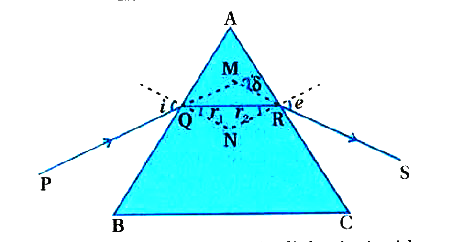
In figure the cross-section perpendicular to the rectangular surface of a prism made up of a transparent medium is shown.

A ray of monochromatic light is incident at point Q on the AB surface of the prism.
According to Snell.s Law, it is refracted and travels along path QR. It experiences deviation `delta_1`, at point Q.
Ray QR is incident on surface AC at point R and suffering deviation `delta_2`, due to refraction emerges in the direction RS.
If the incident ray PQ is extended it advances in QE direction. When the emergent ray RS is extended backwards it meets PE in D.
Incidence angle : Angle made by incident ray at a point on surface with normal is called incidence angle.
`anglePQK = i`
Refracted angle : Angle made by refracted ray at a point on surface with normal is called refracted angle. `angleRQL = r_1`, and `angleQRL = r_2`
Emergence angle : Angle made by emergent ray with normal of surface is called emergence angle.
`angle`TRS = e
Angle of Deviation : “Angle between incident ray and emergent ray is called angle of deviation `(delta)`”.
`angle epsilon DS =delta`
In the figure in `squareAQLR,`
`angleAQL = 90^@` and `angleARL= 90^@` are right angle.
`therefore angleA+angleQLR=180^@` ... (1)
Now, in `triangleQLR`
`r_1+r_2+angleQLR=180^@` ...(2)
From equation (1) and (2),
`r_1+r_2+angleQLR=angleA+angleQLR=180^@`
`therefore r_1+r_2=angleA` ... (3)
From the geometry of the figure angle of deviation `delta` is the exterior angle for `angleDQR i.e. angleEDS = angleDOR`
`therefore angleEDS=angleDQR+angleDRQ`
`therefore delta=delta_1+delta_2`
but, `angleDQR = angleDQL – angleRQL `
`delta_1=i-r_1` [`because angle PQK=angleDQL=i]`
and,`angleDRQ=angleDRL-angleQRL`
`delta_2=e-r_2` So, equation (4)
`delta=i-r_1+e-r_2`
`delta=i+e-(r_1+r_2)`
`thereforedelta=i+e-A` [`because` equation (3)]
`thereforei+e=A+delta`
This equation gives the relation between angle of deviation, angle of incident, angle of emergence and angle of prism.
From above equation we say that angle of deviation depends on the angle of incidence.
Promotional Banner

Topper's Solved these Questions

  • RAY OPTICS AND OPTICAL INSTRUMENTS

    KUMAR PRAKASHAN|Exercise SECTION - A (TRY YOURSELF)|74 Videos
  • RAY OPTICS AND OPTICAL INSTRUMENTS

    KUMAR PRAKASHAN|Exercise SECTION-B (NUMERICALS)(NUMERICAL FROM TEXTUAL ILLUSTRATIONS)|17 Videos
  • MOVING CHARGES AND MAGNETISM

    KUMAR PRAKASHAN|Exercise SECTION D (MCQs ASKED IN COMPETITIVE EXAMS)|34 Videos
  • SAMPLE QUESTION PAPER

    KUMAR PRAKASHAN|Exercise PART-B SECTION-C|5 Videos

Similar Questions

Explore conceptually related problems

What is a triangular glass prism?

In dispersion of white light due to a triangular glass prism, the deviation of red colour is less compared to violet colour. The reason …

State the causes of dispersion of white light as it passes through a triangular glass prism.

In the above figure a narrow beam of white light is shown to pass through a triangular glass prism. After passing through the prism, it produces a spectrum XY on a screen. State the colour seen at (i) X and (ii) Y.

When a beam of white light is passed through a triangular glass prism, it gets dispersed into its component colours. Why do we get these colours ? In the given figure, the colours X and Y represent the extreme components of the spectrum. Identify X and Y.

What is the angle of a prism? What is its value in case of an equilateral triangular prism?

The graph between angle of deviation (delta) and angle of incidence (i) for a triangular prism is represented by

The refractive indices of the crown glass for violet and red lights are 1.51 and 1.49 respectively and those of the flint glass are 1.77 and 1.73 respectively A prism of angle 6^(@) is made of crown glass .A beam of white light is incident at a small angle on this prism.The other thin flint glass prism is combined white the crown glass prism such that te net mean deviation is 1.5^(@) anticlockwise. (i)Determine the angle of the flint glass prism. (ii)A screen is placed normal to the emerging beam at a distance of 2m from the prism combination.find the distance between red and violet spot on the screen Which is the topmost colour on screen.

Describe the activity to show that the colours of white light splitted by a glass prism can be recombined to get white light by another identical glass prism. Also draw ray diagram to show the recombination of the spectrum of white light.

A parallel beam of light is incident from air at an angle alpha on the side of right angled triangular prism of refractive index mu = sqrt(2) . Light undergoes total internal reflection in the prism at the face PR when alpha has a minimum value of 45^@ . The angle theta of the prism is. .

KUMAR PRAKASHAN-RAY OPTICS AND OPTICAL INSTRUMENTS-SECTION-D (MULTIPLE CHOICE QUESTIONS (MCQs))(MCQs ASKED IN COMPETITIVE EXAMS)
  1. Derive i+e=A+delta for a triangular glass prism.

    Text Solution

    |

  2. Which of the following is used in optical fibres ?

    Text Solution

    |

  3. An astronomical telescope has a large aperture to ….. .

    Text Solution

    |

  4. If two mirrors are kept at 60^@ to each other, then the number of imag...

    Text Solution

    |

  5. As shown in figure, a plano-convex lens of focal length 20 cm is silve...

    Text Solution

    |

  6. A light ray is incident perpendicular to one face of a 90^@ prism and ...

    Text Solution

    |

  7. A plano- convex lens of refractive index 1.5 and radius of curvature 3...

    Text Solution

    |

  8. The refractive index of transparent cylindrical rod is (2)/(root3) . A...

    Text Solution

    |

  9. A fish looking up through the water sees the outside world, contained ...

    Text Solution

    |

  10. Two point white dots are 1 mm apart on a black paper. They are viewed ...

    Text Solution

    |

  11. A thin glass (refractive index 1.5) lens has optical power of - 5D in ...

    Text Solution

    |

  12. The refractive index of glass is 1.520 for red light and 1.525 for blu...

    Text Solution

    |

  13. Two lenses of power - 15D and + 5D are in contact with each other. The...

    Text Solution

    |

  14. When monochromatic red light is used instead of blue light in a convex...

    Text Solution

    |

  15. A beaker contains water up to a height h(1) and kerosene of height h(2...

    Text Solution

    |

  16. Diameter of a plano-convex lens is 6 cm and thickness at the centre is...

    Text Solution

    |

  17. A green light is incident from the water to the air-water interface at...

    Text Solution

    |

  18. Monochromatic light is incident on a glass prism of angle A. If the re...

    Text Solution

    |

  19. On a hot summer night, the refractive index of air is smallest near th...

    Text Solution

    |

  20. An observer looks at a distant tree of height 10 m with a telescope of...

    Text Solution

    |

  21. A diverging lens with magnitude of focal length 25 cm is placed at a d...

    Text Solution

    |

