Home
Class 12
PHYSICS
A mobile phone lies along the principal ...

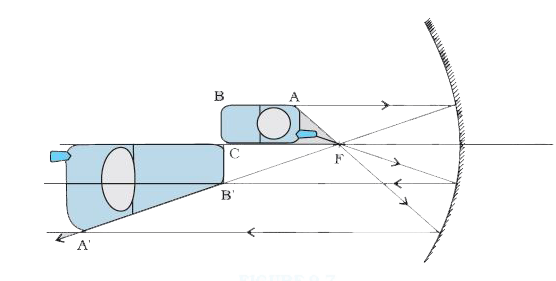
A mobile phone lies along the principal axis of a concave mirror, as shown in Fig. 9.7. Show by suitable diagram, the formation of its image. Explain why the magnification is not uniform. Will the distortion of image depend on the location of the phone with respect to the mirror?

Text Solution

Verified by Experts

`rArr` Mobile AB is placed such that is end B is at C and end A is between C and F.
`rArr` Image of B is obtained on the same plane but inverted at C is B.
`rArr` Image of A is obtained on the same plane but inverted at C is B.
`rArr` Image of A is obtained away from mirror beyond C and inverted and it is A. magnified than A.
`rArr` Thus, magnification `m= -(v)/(u)` will not be same for all points as v and u are different.
`rArr` Yes, magnification of image changes with change in distance of mobile from mirror. Hence, distorted image is obtained.
Promotional Banner

Topper's Solved these Questions

  • RAY OPTICS AND OPTICAL INSTRUMENTS

    KUMAR PRAKASHAN|Exercise SECTION-B (NUMERICALS)(NUMERICAL FROM TEXTUAL EXERCISE)|45 Videos
  • RAY OPTICS AND OPTICAL INSTRUMENTS

    KUMAR PRAKASHAN|Exercise SECTION-B (NUMERICALS)(NUMERICAL FROM .DARPAN. BASED ON TEXTBOOK )|12 Videos
  • RAY OPTICS AND OPTICAL INSTRUMENTS

    KUMAR PRAKASHAN|Exercise SECTION - A (TRY YOURSELF)|74 Videos
  • MOVING CHARGES AND MAGNETISM

    KUMAR PRAKASHAN|Exercise SECTION D (MCQs ASKED IN COMPETITIVE EXAMS)|34 Videos
  • SAMPLE QUESTION PAPER

    KUMAR PRAKASHAN|Exercise PART-B SECTION-C|5 Videos

Similar Questions

Explore conceptually related problems

An infinitely long rod lies along the axis of a concave mirror of focal length f. The near end of the rod is distance u gt f from the mirror. Its image will have length

A short linear object of length b lies along the axis of a concave mirror of focal length f at a distanee u from the pole of the mirror. The size of the image is approximately equal to

A particle is dropped along the axis from a height (f)/(2) on a concave mirror of focal length f as shown in figure. Find the maximum speed of image .

As shown in the figure, a thin rod AB of length 10 cm is placed on the principal axis of a concave mirror such that it.s end B is at a distance of 40 cm from the mirror. If the focal length of the mirror is 20 cm, find the length of the image of the rod

A short object of length L is placed along the principal axis of a concave mirror away from focus. The object distance is u. If the mirror has a focal length f, what will be the length of the image ? You may take L lt lt |v- f|.

A convex lens of focal length 15 cm and a concave mirror of focal length 30 cm are kept with their optic axis PQ and RS parallel but separated in vertical directiion by 0.6 cm as shown . The distance between the lens and mirror is 30 cm . An upright object AB of height 1.2 cm is placed on the optic axis PQ of the lens at a distance of 20 cm from the lens . if A'B' is the image after refraction from the lens and the reflectiion from the mirror , find the distance of A'B' from the pole of the mirror and obtain its magnification . Also locate positions of A' and B' with respect to the optic axis RS.

When a pin is moved along the principal axis of a small concave mirror, the image position coincides with the object at a point 0.5 m from the mirror refer figure . If the mirror is placed at a depth of 0.2 m in a transparent liquid, the same phenomenon occurs when the pin is placed 0.4 m from the mirror . The refractive index of the liquid is :-

A thin rod of length f//3 is placed along the optic axis of a concave mirror of focal length f such that its image which is real and elongated, just touches the rod. The magnification is "_____________"

In an experiment to determine the focal length (f) of a concave mirror by the u-v method, a student places the object pin A on the principal axis at a distance x from the pole P. The student looks at the pin and its inverted image from a distance keeping his/her eye in line with PA. When the student shifts his/her eye towards left, the image appears to the right of the object pin. Then,

KUMAR PRAKASHAN-RAY OPTICS AND OPTICAL INSTRUMENTS-SECTION-B (NUMERICALS)(NUMERICAL FROM TEXTUAL ILLUSTRATIONS)
  1. Suppose that the lower half of the concave mirror.s reflecting surface...

    Text Solution

    |

  2. Suppose that the upper half of the concave mirror.s reflecting surface...

    Text Solution

    |

  3. A mobile phone lies along the principal axis of a concave mirror, as s...

    Text Solution

    |

  4. As shown in the figure, a thin rod AB of length 10 cm is placed on the...

    Text Solution

    |

  5. An object is placed at (i) 10 cm, (ii) 5 cm in front of a concave mirr...

    Text Solution

    |

  6. An object is placed at 30 cm in front of a concave mirror of radius of...

    Text Solution

    |

  7. Suppose while sitting in a parked car, you notice a jogger approaching...

    Text Solution

    |

  8. Suppose while sitting in a parked car, you notice a jogger approaching...

    Text Solution

    |

  9. The earth takes 24 h to rotate once about its axis. How much time does...

    Text Solution

    |

  10. The earth takes 24 h to rotate once about its axis. How much time does...

    Text Solution

    |

  11. Light from a point source in air falls on a spherical glass surface (n...

    Text Solution

    |

  12. Light from a point source in air falls on a spherical glass surface (n...

    Text Solution

    |

  13. A magician during a show makes a glass lens with n=1.47 disappear in t...

    Text Solution

    |

  14. (i) If f = 0.5 m for a glass lens, what is the power of the lens? (ii)...

    Text Solution

    |

  15. (i) If f =- 0.2 m for a glass lens, what is the power ofthe lens? (...

    Text Solution

    |

  16. Find the position of the image formed by the lens combination given in...

    Text Solution

    |

  17. Decide the position of the image formed by the given combination of le...

    Text Solution

    |
