Home
Class 12
PHYSICS
Find the position of the image formed by...

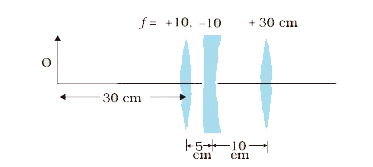
Find the position of the image formed by the lens combination given in the Fig.

Text Solution

Verified by Experts

`rArr` For the image formed by first lens,
`1/(v_1)- (1)/(u_1) = 1/f`
`therefore (1)/(v_1) - (1)/(-30) = 1/10`
`therefore v_1 = 15 cm `
`rArr` Thus image formed by the first lens is formed at 15 cm distance on the right-hand side. This image is on the right-hand side of the second lens at 15 - 5 = 10 cm distance and so it acts as a vlrlual object for the second lens.
`rArr` Now for the second lens ,
`(1)/(v_2) - (1)/(u_2) = (1)/(f_2)`
`therefore 1/(v_2) - (1)/(10) = (1)/(10) " " [ therefore` According to sign convention ]
`therefore v_2 = oo`
This distance `v_2 ( = oo)` is the object distance fOl the third lens. So, the third image formed due to it should be on the principal focus of the third lens. Thus, as the focal length ofthe third lens is 30 cm the final image is formed at 30 cm distance on the right side of the third lens.
For the third lens,
`(1)/(v_3) - (1)/(u_3) = (1)/(f_3)`
`therefore (1)/(v_3) - (1)/(oo) = (1)/(30)`
`therefore (1)/(v_3) = (1)/(30)`
`therefore v_3 = 30 cm `
`therefore` Final image is formed at 30 cm distance on the right side of the third lens.
Promotional Banner

Topper's Solved these Questions

  • RAY OPTICS AND OPTICAL INSTRUMENTS

    KUMAR PRAKASHAN|Exercise SECTION-B (NUMERICALS)(NUMERICAL FROM TEXTUAL EXERCISE)|45 Videos
  • RAY OPTICS AND OPTICAL INSTRUMENTS

    KUMAR PRAKASHAN|Exercise SECTION-B (NUMERICALS)(NUMERICAL FROM .DARPAN. BASED ON TEXTBOOK )|12 Videos
  • RAY OPTICS AND OPTICAL INSTRUMENTS

    KUMAR PRAKASHAN|Exercise SECTION - A (TRY YOURSELF)|74 Videos
  • MOVING CHARGES AND MAGNETISM

    KUMAR PRAKASHAN|Exercise SECTION D (MCQs ASKED IN COMPETITIVE EXAMS)|34 Videos
  • SAMPLE QUESTION PAPER

    KUMAR PRAKASHAN|Exercise PART-B SECTION-C|5 Videos

Similar Questions

Explore conceptually related problems

Decide the position of the image formed by the given combination of lenses.

Write equation for image formed by thin lens.

A convex lens of focal length 30 cm , a concave lens of focal length 120 cm , and a plane mirror are arranged as shown . For an object kept at a distance of 60 cm from the convex lens, the final image, formed by the combination , is a real image , at a distance of : |"Focal length" | = |"Focal length"| = 30 cm " " =120 cm

Plane mirrors are arranged parallel to each other as shown in column-I and the number of images formed by the combination is in column- II

Consider a concave mirror and a convex lens (refractive index 1.5) of focal length 10 cm each separated by a distance of 50 cm in air (refractive index = 1) as shown in the Fig. An object is placed at a distance of 15 cm from the mirror. Its erect image formed by this combination has magnification M_1 . When this set up is kept in a medium of refractive index 7//6 , the magnification becomes M_2 . The magnitude ((M_2)/(M_1)) is : .

In the figure shown L is converging lens of focal length 10 cm and M is a concave mirror of radius of curvature 20 cm . A point object O is placed in front of the lens at a distance 15 cm . AB and CD are optical axes of the lens mirror respectively. Find the coordinates of the final image formed by this system taking O as origin. The distance between CD & AB is 1mm.

A point object is kept at a distance of 2 m from a parabolic reflecting surface y^(2) = 2x . An equiconvex lens is kept at a distance of 1.80 m from the parabolic surface. The focal length of the lens is 20 cm . Find the position from origin of the image in cm, after reflection from the surface.

An object to the left of a lens is imaged by the lens on a screen 30cm to the right of the lens. When the lens is moved 5cm to the right, the screen must be moved 5cm to the left to refocus the images. The focal length of lens is :-

(a) For the telescope described in Exercise 9.28 (a), what is the separation between the objective lens and the eyepiece? (b) If this telescope is used to view a 100 m tall tower 3 km away, what is the height of the image of the tower formed by the objective lens? (c) What is the height of the final image of the tower if it is formed at 25cm?

The image formed by an objective of a telescope is-

KUMAR PRAKASHAN-RAY OPTICS AND OPTICAL INSTRUMENTS-SECTION-B (NUMERICALS)(NUMERICAL FROM TEXTUAL ILLUSTRATIONS)
  1. Suppose that the lower half of the concave mirror.s reflecting surface...

    Text Solution

    |

  2. Suppose that the upper half of the concave mirror.s reflecting surface...

    Text Solution

    |

  3. A mobile phone lies along the principal axis of a concave mirror, as s...

    Text Solution

    |

  4. As shown in the figure, a thin rod AB of length 10 cm is placed on the...

    Text Solution

    |

  5. An object is placed at (i) 10 cm, (ii) 5 cm in front of a concave mirr...

    Text Solution

    |

  6. An object is placed at 30 cm in front of a concave mirror of radius of...

    Text Solution

    |

  7. Suppose while sitting in a parked car, you notice a jogger approaching...

    Text Solution

    |

  8. Suppose while sitting in a parked car, you notice a jogger approaching...

    Text Solution

    |

  9. The earth takes 24 h to rotate once about its axis. How much time does...

    Text Solution

    |

  10. The earth takes 24 h to rotate once about its axis. How much time does...

    Text Solution

    |

  11. Light from a point source in air falls on a spherical glass surface (n...

    Text Solution

    |

  12. Light from a point source in air falls on a spherical glass surface (n...

    Text Solution

    |

  13. A magician during a show makes a glass lens with n=1.47 disappear in t...

    Text Solution

    |

  14. (i) If f = 0.5 m for a glass lens, what is the power of the lens? (ii)...

    Text Solution

    |

  15. (i) If f =- 0.2 m for a glass lens, what is the power ofthe lens? (...

    Text Solution

    |

  16. Find the position of the image formed by the lens combination given in...

    Text Solution

    |

  17. Decide the position of the image formed by the given combination of le...

    Text Solution

    |
