Home
Class 12
PHYSICS
(a) Figure 9.32 shows a cross-section of...

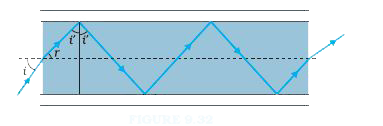
(a) Figure 9.32 shows a cross-section of a 'light pipe' made of a glass fibre of refractive index 1.68. The outer covering of the pipe is made of a material of refractive index 1.44. What is the range of the angles of the incident rays with the axis of the pipe for which total reflections inside the pipe take place, as shown in the figure.

(b) What is the answer if there is no outer covering of the pipe?

Text Solution

Verified by Experts

`rArr` Here, `mu_1 = 1.44 mu_2 = 1.68`
`mu_(2) = (mu_2)/(mu_1) = (1)/(sin i._c)`
But sin `i_(c) = (mu_1)/(mu_2) = (1.44)/(1.68) = 0.8571`
`therefore i._(c) ~~ 59^@`
`rArr "If" i. gt i._c`, then total internal refraction
Hence, if `i gt 59^@` of
refraction angle `r lt r_("max")`
where `r_("max") = 90^@ - 59^@ = 31^@`
`therefore` From Snell.s law,
`(sin i_(max))/(sin r_(max)) = mu = 1.68`
`therefore sin i_(max) = 1.68 xx sin r_(max)`
`= 1.68 xx sin 31^@`
`= 1.68 xx 0.5150`
`= 0.8662`
`therefore sin i_(max) ~~ 60^@`
`therefore` Rays enter at `0 lt i lt 60^@` with axis of cylinder perform total internal refraction.
`rArr` For limited length of pipe, minimum value of incidence angle can be decided by ration of diameter and length of pipe.
(b) If there is no layer outside of pipe, then
`sin i.c = (mu_1)/(mu_2)` where `mu_1 =1, mu_2 = 1.68`
`= 1/ 1.68 = 0.5952`
`therefore i_c = 36.5^@`
`therefore` F or `i = 36.5^@, r = 36.5^@ and i. = 90^@ - 36.5^@`
`therefore i = 53.5^@`
Thus , `i gt i_c` hence `0 lt i lt 90^@` , so all the rays perform total internal refraction.
Promotional Banner

Topper's Solved these Questions

  • RAY OPTICS AND OPTICAL INSTRUMENTS

    KUMAR PRAKASHAN|Exercise SECTION-B (NUMERICALS)(NUMERICAL FROM .DARPAN. BASED ON TEXTBOOK )|12 Videos
  • RAY OPTICS AND OPTICAL INSTRUMENTS

    KUMAR PRAKASHAN|Exercise SECTION-C (NCERT EXEMPLAR SOLUTION) (MULTIPLE CHOICE QUESTIONS (MCQs))|16 Videos
  • RAY OPTICS AND OPTICAL INSTRUMENTS

    KUMAR PRAKASHAN|Exercise SECTION-B (NUMERICALS)(NUMERICAL FROM TEXTUAL ILLUSTRATIONS)|17 Videos
  • MOVING CHARGES AND MAGNETISM

    KUMAR PRAKASHAN|Exercise SECTION D (MCQs ASKED IN COMPETITIVE EXAMS)|34 Videos
  • SAMPLE QUESTION PAPER

    KUMAR PRAKASHAN|Exercise PART-B SECTION-C|5 Videos

Similar Questions

Explore conceptually related problems

A prism of refractive index 1.53 is placed in water of refractive index 1.33 . If the angle of prism is 60^@ , calculate the angle of minimum deviation in water.

Flint glass lens is made of refractive index 1.5. When it is placed in a liquid of refractive index 1.25, then its focal length will be ....

A ray of light incident at an angle theta on a refracting face of a prism emerges from the other face normally. If the angle of the prism is 5^@ and the prism is made of a material of refractive index 1.5, the angle of incidence is

A ray of light passes from a medium A having refractive index 1.6 to the medium B having refractive index 1.5. The value of critical angle of medium A is ....

A ray of light falls on a transparent glass slab of refractive index 1.62 . If the reflected ray and the refracted rays are mutually perpendicular, what is the angle of refraction ?

Ray of light is incident on surface of glass plate of absolute refractive index 1.55 at an angle of polarisation angle of refraction = ......

A prism of refractive index sqrt(2) has refractive angle 60^(@) . Find the angle of incidence so that a ray minimum deviation.

Monochromatic light is incident on a glass prism of angle A. If the refractive index of the material of the prism is mu , a ray, incident at an angle theta , on the face AB would get transmitted through the face AC pf the prism provided.

A cubical block of glass of refractive index n_1 is in contact with the surface of water of refractive index n_2. A beam of light is incident on vertical face of the block. After refraction a total internal reflection at the base and refraction at the opposite face take place. The ray emerges at angle theta as shown. The value of theta is given by

KUMAR PRAKASHAN-RAY OPTICS AND OPTICAL INSTRUMENTS-SECTION-B (NUMERICALS)(NUMERICAL FROM TEXTUAL EXERCISE)
  1. Use the mirror equation to deduce that: (a) an object placed between...

    Text Solution

    |

  2. A small pin fixed on a table top is viewed from above from a distance ...

    Text Solution

    |

  3. (a) Figure 9.32 shows a cross-section of a 'light pipe' made of a glas...

    Text Solution

    |

  4. Answer the following questions: (a) You have learnt that plane and c...

    Text Solution

    |

  5. Answer the following questions: (b) A virtual image, we always say, ...

    Text Solution

    |

  6. Answer the following questions: (c) A diver under water, looks obliq...

    Text Solution

    |

  7. Answer the following questions: (d) Does the apparent depth of a tan...

    Text Solution

    |

  8. Answer the following questions: (e) The refractive index of diamond ...

    Text Solution

    |

  9. The image of a small electric bulb fixed on the wall of a room is to b...

    Text Solution

    |

  10. A screen is placed 90cm from an object. The image of the object on the...

    Text Solution

    |

  11. Determine the .effective focal length. of the combination of the two l...

    Text Solution

    |

  12. An object 1.5 cm in size is placed on the side of the convex lens in t...

    Text Solution

    |

  13. At what angle should a ray of light be incident on the face of a prism...

    Text Solution

    |

  14. A card sheet divided into squares each of size 1 mm^(2) is being viewe...

    Text Solution

    |

  15. (a) At what distance should the lens be held from the figure in Exerci...

    Text Solution

    |

  16. What is the magnification in this case ?

    Text Solution

    |

  17. (a) At what distance should the lens be held from the figure in Exerci...

    Text Solution

    |

  18. What should be the distance between the object in Exercise 9.24 and th...

    Text Solution

    |

  19. Answer the following questions: (a) The angle subtended at the eye b...

    Text Solution

    |

  20. Answer the following questions: (b) In viewing through a magnifying ...

    Text Solution

    |
