Home
Class 12
PHYSICS
Answer the following questions: (a) Yo...

Answer the following questions:
(a) You have learnt that plane and convex mirrors produce virtual images of objects. Can they produce real images under some circumstances? Explain.

Text Solution

Verified by Experts
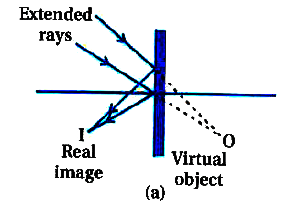
When object is placed behing plane of convex mirror, the rays coming out through reflection of mirror will intersect at a point in front of mirror, In other words, If objects in virtual , then by plane or convex mirror, real image can be obtained. Its ray diagram is as below.
Promotional Banner

Topper's Solved these Questions

  • RAY OPTICS AND OPTICAL INSTRUMENTS

    KUMAR PRAKASHAN|Exercise SECTION-B (NUMERICALS)(NUMERICAL FROM .DARPAN. BASED ON TEXTBOOK )|12 Videos
  • RAY OPTICS AND OPTICAL INSTRUMENTS

    KUMAR PRAKASHAN|Exercise SECTION-C (NCERT EXEMPLAR SOLUTION) (MULTIPLE CHOICE QUESTIONS (MCQs))|16 Videos
  • RAY OPTICS AND OPTICAL INSTRUMENTS

    KUMAR PRAKASHAN|Exercise SECTION-B (NUMERICALS)(NUMERICAL FROM TEXTUAL ILLUSTRATIONS)|17 Videos
  • MOVING CHARGES AND MAGNETISM

    KUMAR PRAKASHAN|Exercise SECTION D (MCQs ASKED IN COMPETITIVE EXAMS)|34 Videos
  • SAMPLE QUESTION PAPER

    KUMAR PRAKASHAN|Exercise PART-B SECTION-C|5 Videos

Similar Questions

Explore conceptually related problems

Answer the following questions: (b) As you have learnt in the text, the principle of linear superposition of wave displacement is basic to understanding intensity distributions in diffraction and interference patterns. What is the justification of this principle?

Answer the following questions: (a) The angle subtended at the eye by an object is equal to the angle subtended at the eye by the virtual image produced by a magnifying glass. In what sense then does a magnifying glass provide angular magnification?

Use the mirror equation to deduce that: (a) an object placed between f and 2f of a concave mirror produces a real image beyond 2f. (b) a convex mirror always produces a virtual image independent of the location of the object. (c) the virtual image produced by a convex mirror is always diminished in size and is located between the focus and the pole. (d) an object placed between the pole and focus of a concave mirror produces a virtual and enlarged image.

Use the mirror equation to deduce that: (a) An object placed between f and 2f of a concave mirror produces a real image beyond 2f. (b) A convex mirror always produce a virtual image independent of the location of the object. ( c) The virtual image produced by a convex mirror is always diminished in size and it located between the focus and the pole.

Answer the following questions: (b) A virtual image, we always say, cannot be caught on a screen. Yet when we 'see' a virtual image, we are obviously bringing it on to the 'screen' (i.e., the retina) of our eye. Is there a contradiction?

You have learnt in the text how Huygens’ principle leads to the laws of reflection and refraction. Use the same principle to deduce directly that a point object placed in front of a plane mirror produces a virtual image whose distance from the mirror is equal to the object distance from the mirror

KUMAR PRAKASHAN-RAY OPTICS AND OPTICAL INSTRUMENTS-SECTION-B (NUMERICALS)(NUMERICAL FROM TEXTUAL EXERCISE)
  1. A small pin fixed on a table top is viewed from above from a distance ...

    Text Solution

    |

  2. (a) Figure 9.32 shows a cross-section of a 'light pipe' made of a glas...

    Text Solution

    |

  3. Answer the following questions: (a) You have learnt that plane and c...

    Text Solution

    |

  4. Answer the following questions: (b) A virtual image, we always say, ...

    Text Solution

    |

  5. Answer the following questions: (c) A diver under water, looks obliq...

    Text Solution

    |

  6. Answer the following questions: (d) Does the apparent depth of a tan...

    Text Solution

    |

  7. Answer the following questions: (e) The refractive index of diamond ...

    Text Solution

    |

  8. The image of a small electric bulb fixed on the wall of a room is to b...

    Text Solution

    |

  9. A screen is placed 90cm from an object. The image of the object on the...

    Text Solution

    |

  10. Determine the .effective focal length. of the combination of the two l...

    Text Solution

    |

  11. An object 1.5 cm in size is placed on the side of the convex lens in t...

    Text Solution

    |

  12. At what angle should a ray of light be incident on the face of a prism...

    Text Solution

    |

  13. A card sheet divided into squares each of size 1 mm^(2) is being viewe...

    Text Solution

    |

  14. (a) At what distance should the lens be held from the figure in Exerci...

    Text Solution

    |

  15. What is the magnification in this case ?

    Text Solution

    |

  16. (a) At what distance should the lens be held from the figure in Exerci...

    Text Solution

    |

  17. What should be the distance between the object in Exercise 9.24 and th...

    Text Solution

    |

  18. Answer the following questions: (a) The angle subtended at the eye b...

    Text Solution

    |

  19. Answer the following questions: (b) In viewing through a magnifying ...

    Text Solution

    |

  20. Answer the following questions: (c) Magnifying power of a simple mic...

    Text Solution

    |

