Home
Class 12
PHYSICS
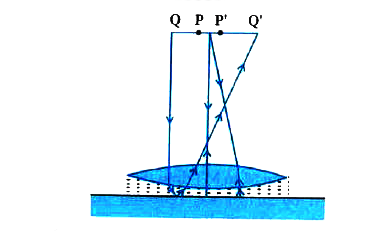
Figure shows an equiconvex lens (of ref...

Figure shows an equiconvex lens (of refractive index 1.50) in contact with a liquid layer on top of a plane mirror. A small needle with its tip on the principal axis is moved along the axis until its inverted image is found at the position of the needle. The distance of the needle from the lens is measured to be 45.0 cm. The liquid is removed and the experiment is repeated. The new distance is measured to be 30.0 cm. What is the refractive index of the liquid ?

Text Solution

Verified by Experts

`rArr` Suppose, focal length of convex lens `f_1 = 30` cm and focal length of plano concave lens of liquid `f_2` and focal length of combination F = 45.0 cm
`rArr` Focal length of combination,
`1/F = 1/f_1 + 1/f_2`
`therefore 1/(f_2) = 1/F - 1/f_1`
`therefore 1/(f_2) = 1/45 -1 /30 = (2-3)/(90) = - (1)/(90)`
`therefore f_2 = -90 cm`
`rArr` For glass lens, suppose `R_1 = R, R_2 = - R`
`(1)/(f_1) = (mu -1) [ (1)/(R_1) - (1)/(R_2)]`
`(1)/(30) = [(3)/(2) -1][1/R - (1)/(-R)]`
`1/30 = 1/2 xx 2/R`
`therefore R = 30 cm `
`rArr` For lens of liquid,
`f_2 =- 90 cm , R_1 = -R = - 30 cm ` and `R_2 = oo`
`therefore` Lens maker.s formula,
`1/(f_2 ) = (mu_l-1)[(1)/(R_1) - (1)/(R_2)]`
`(1)/(-90) = (mu_l -1)[1/-R - 1/oo]`
`1/(-90) = (mu_1 -1) [ 1/-R][because 1/oo = 0]`
`therefore (1)/(-90) = (mu_1 -1)[1/-30]`
`therefore mu_l -1 = 1/3`
`therefore mu_l = 4/3 = 1.33`
Promotional Banner

Topper's Solved these Questions

  • RAY OPTICS AND OPTICAL INSTRUMENTS

    KUMAR PRAKASHAN|Exercise SECTION-B (NUMERICALS)(NUMERICAL FROM .DARPAN. BASED ON TEXTBOOK )|12 Videos
  • RAY OPTICS AND OPTICAL INSTRUMENTS

    KUMAR PRAKASHAN|Exercise SECTION-C (NCERT EXEMPLAR SOLUTION) (MULTIPLE CHOICE QUESTIONS (MCQs))|16 Videos
  • RAY OPTICS AND OPTICAL INSTRUMENTS

    KUMAR PRAKASHAN|Exercise SECTION-B (NUMERICALS)(NUMERICAL FROM TEXTUAL ILLUSTRATIONS)|17 Videos
  • MOVING CHARGES AND MAGNETISM

    KUMAR PRAKASHAN|Exercise SECTION D (MCQs ASKED IN COMPETITIVE EXAMS)|34 Videos
  • SAMPLE QUESTION PAPER

    KUMAR PRAKASHAN|Exercise PART-B SECTION-C|5 Videos

Similar Questions

Explore conceptually related problems

A magician during a show makes a glass lens with n=1.47 disappear in the trough of liquid. What is the refractive index of the liquid.

What is the length of the image of the rod in mirror, according to the observer in air? (refractive index of the liquid is mu )

A biconvex lens of focal length 15 cm is in front of a plane mirror. The distance between the lens and the mirror is 10 cm. A small object is kept at a distance of 30 cm from the lens. The final image is

When a pin is moved along the principal axis of a small concave mirror, the image position coincides with the object at a point 0.5 m from the mirror refer figure . If the mirror is placed at a depth of 0.2 m in a transparent liquid, the same phenomenon occurs when the pin is placed 0.4 m from the mirror . The refractive index of the liquid is :-

Flint glass lens is made of refractive index 1.5. When it is placed in a liquid of refractive index 1.25, then its focal length will be ....

Two point objects are placed on principal axis of a thin converging lens. One is 20cm from the lens and other is on the other side of lens at a distance of 40 cm from the lens. The images of both objects coincide. The magnitude of focal length of lens is :-

A 20cm thick glass slab of refractive index 1.5 is kept in front of a plane mirror. Find the position of the image (relative to mirror) as seen by an observer through the glass slab when a point object is kept in air at a distance of 40 cm from the mirror.

KUMAR PRAKASHAN-RAY OPTICS AND OPTICAL INSTRUMENTS-SECTION-B (NUMERICALS)(NUMERICAL FROM TEXTUAL EXERCISE)
  1. An object 1.5 cm in size is placed on the side of the convex lens in t...

    Text Solution

    |

  2. At what angle should a ray of light be incident on the face of a prism...

    Text Solution

    |

  3. A card sheet divided into squares each of size 1 mm^(2) is being viewe...

    Text Solution

    |

  4. (a) At what distance should the lens be held from the figure in Exerci...

    Text Solution

    |

  5. What is the magnification in this case ?

    Text Solution

    |

  6. (a) At what distance should the lens be held from the figure in Exerci...

    Text Solution

    |

  7. What should be the distance between the object in Exercise 9.24 and th...

    Text Solution

    |

  8. Answer the following questions: (a) The angle subtended at the eye b...

    Text Solution

    |

  9. Answer the following questions: (b) In viewing through a magnifying ...

    Text Solution

    |

  10. Answer the following questions: (c) Magnifying power of a simple mic...

    Text Solution

    |

  11. Answer the following questions: (d) Why must both the objective and ...

    Text Solution

    |

  12. Answer the following questions: (e) When viewing through a compound ...

    Text Solution

    |

  13. An angular magnification (magnifying power) of 30X is desired using an...

    Text Solution

    |

  14. A small telescope has an objective lens of focal length 140cm and an e...

    Text Solution

    |

  15. For the telescope described in Exercise 9.3 (a), what is the separatio...

    Text Solution

    |

  16. If this telescope is used to view a 100 m tall tower 3 km away, what i...

    Text Solution

    |

  17. (a) For the telescope described in Exercise 9.28 (a), what is the sepa...

    Text Solution

    |

  18. A Cassegrain telescope uses two mirrors as shown in Fig. 9.30. Such a ...

    Text Solution

    |

  19. Light incident normally on a plane mirror attached to a galvanometer c...

    Text Solution

    |

  20. Figure shows an equiconvex lens (of refractive index 1.50) in contact...

    Text Solution

    |
