Home
Class 12
PHYSICS
The optical density of turpentine is hig...

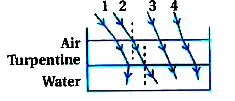
The optical density of turpentine is higher than that of water while its mass density is lower. Figure shows a layer of turpentine floating over water in a container. For which one of the four rays incident on turpentine in as figure, the path shown is correct?

A

1

B

2

C

3

D

4

Text Solution

Verified by Experts

The correct Answer is:

B

When a ray of light enters turpentine from air, it bends towards normal (as it enters from rarer to denser medium) and then when it enters air from turpentine, it bends away from normal (as it enters from denser to rarer medium).
In the figure, path of light ray no. 2 is correct as it follows the path in above manner.
Promotional Banner

Topper's Solved these Questions

  • RAY OPTICS AND OPTICAL INSTRUMENTS

    KUMAR PRAKASHAN|Exercise SECTION-C (NCERT EXEMPLAR SOLUTION) (VERY SHORT ANSWER TYPE QUESITONS)|5 Videos
  • RAY OPTICS AND OPTICAL INSTRUMENTS

    KUMAR PRAKASHAN|Exercise SECTION-C (NCERT EXEMPLAR SOLUTION) (SHORT ANSWER TYPE QUESITONS)|6 Videos
  • RAY OPTICS AND OPTICAL INSTRUMENTS

    KUMAR PRAKASHAN|Exercise SECTION-B (NUMERICALS)(NUMERICAL FROM .DARPAN. BASED ON TEXTBOOK )|12 Videos
  • MOVING CHARGES AND MAGNETISM

    KUMAR PRAKASHAN|Exercise SECTION D (MCQs ASKED IN COMPETITIVE EXAMS)|34 Videos
  • SAMPLE QUESTION PAPER

    KUMAR PRAKASHAN|Exercise PART-B SECTION-C|5 Videos

Similar Questions

Explore conceptually related problems

Water is filled up to a height h in a beaker of radius R as shown in the figure. The density of water is rho, the surface tension of water is T and the atmospheric pressure is P_0. Consider a vertical section ABCD of the water column through a diameter of the beaker. The force on water on one side of this section by water on the other side of this section has magnitude

The refractive index of transparent cylindrical rod is (2)/(root_3) . As shown in the figure the ray i incident at the mid point of its one end. For which angle of incidence, the ray become parallel to the length of rod ?

String I and II have identical and linear mass densities, but string I is under greater tension than string II . The accompanying figure shows four different situations, A to D , in which standing wave patterns exist on the two strings. In which situation it is possible that strings I and II are oscillating at the same resonant frequency ?

A glass beaker is placed partially filled with water in a sink it has a mass of 390 gm and an interior volume of 500 cm^(2) when water starts filling the sink, it is found that if beaker is less than half full it will float but if it is more than half full it remains on the bottom of the sink as the water rises to its rim, what is the density of the material of which the beaker is made?

When an object moves through a fluid, as when a ball falls through air or a glass sphere falls through water te fluid exerts a viscous foce F on the object this force tends to slow the object for a small sphere of radius r moving is given by stoke's law, F_(w)=6pietarv . in this formula eta in the coefficient of viscosity of the fluid which is the proportionality constant that determines how much tangential force is required to move a fluid layer at a constant speed v, when the layer has an area A and is located a perpendicular distance z from and immobile surface. the magnitude of the force is given by F=etaAv//z . For a viscous fluid to move from location 2 to location 1 along 2 must exceed that at location 1, poiseuilles's law given the volumes flow rate Q that results from such a pressure difference P_(2)-P_(1) . The flow rate of expressed by the formula Q=(piR^(4)(P_(2)-P_(1)))/(8etaL) poiseuille's law remains valid as long as the fluid flow is laminar. For a sfficiently high speed however the flow becomes turbulent flow is laminar as long as the reynolds number is less than approximately 2000. This number is given by the formula R_(e)=(2overline(v)rhoR)/(eta) In which overline(v) is the average speed rho is the density eta is the coefficient of viscosity of the fluid and R is the radius of the pipe. Take the density of water to be rho=1000kg//m^(3) Q. If the sphere in previous question has mass of 1xx10^(-5)kg what is its terminal velocity when falling through water? (eta=1xx10^(-3)Pa-s)

Each phase of a material can exits only in certain regions of pressure and temperature . P-T phase diagrams, in which pressure is plotted versus temperature, show the regions corresponding to various phases and phase transformations . P-V diagrams, on the other hand , can be used to study pressure volume relationship at a constant temperature. If the liquid and gaseous phases of a pure substances are heated together in a closed container, both the temperature and the vapor pressure will increase until a point is reached at which the two phases can no longer be distinguished from one another. The temperature and pressure at which this occurs are called the critical temperature and pressure. Exceeding either of these parameters, by itself ,will cause the "gas"//"liguid" phase transition to disappear. if the other variable is then changed as well, while the first variable is maintained above its critical point , a gradual transition will occur between the gaseous and liquid phases, with no clear boundary.(The liquid and solid phases, on the other hand , maintain a distinct boundary at all pressure above the triple point). Shown in figure is a combined P-T phase diagram for material A and B . If heat is added to solids A and B , each in a container that is open to the atmosphere :-

A fixed thermally conducting cylinder has a radius R and height L_0 . The cylinder is open at its bottom and has a small hole at its top. A piston of mass M is held at a distance L from the top surface, as shown in the figure. The atmospheric pressure is P_0 . The piston is taken completely out of the cylinder. The hole at the top is sealed. A water tank is brought below the cylinder and put in a position so that the water surface in the tank is at the same level as the top of the cylinder as shown in the figure. The density of the water is rho . In equilibrium, the height H of the water coulmn in the cylinder satisfies

A small ball of mass m and charge q is attached to the bottom end of a piece of negligible mass thread of length l, whose top end is fixed. The system formed by the thread and ball is in vertical plane and is in uniform horizontal magnetic field B, which is perpendicular to the plane of figure and points into the paper The ball is started with a velocity v_(0) from lower most point of circle in a direction perpendicular both to the magnetic induction and to direction of thread. The ball moves along a circular path such that thread remains tight during the whole motion. Neglect any loss of enery. By what factor is the force acting on the thread (tension in thread) at point A is greater than at point C, when speed of the ball is the above stated one?

Each phase of a material can exits only in certain regions of pressure and temperature . P-T phase diagrams, in which pressure is plotted versus temperature, show the regions corresponding to various phases and phase transformations . P-V diagrams, on the other hand , can be used to study pressure volume relationship at a constant temperature. If the liquid and gaseous phases of a pure substances are heated together in a closed container, both the temperature and the vapor pressure will increase until a point is reached at which the two phases can no longer be distinguished from one another. The temperature and pressure at which this occurs are called the critical temperature and pressure. Exceeding either of these parameters, by itself ,will cause the "gas"//"liguid" phase transition to disappear. if the other variable is then changed as well, while the first variable is maintained above its critical point , a gradual transition will occur between the gaseous and liquid phases, with no clear boundary.(The liquid and solid phases, on the other hand , maintain a distinct boundary at all pressure above the triple point). Shown in figure is a combined P-T phase diagram for material A and B . Which is true about the substance in figure?

The direction of ray of light incident on a concave mirror is shown by PQ while directions in which the ray would travel after reflection is shown by four rays marked 1, 2, 3 and 4 (See figure). Which of the four rays correctly shows the direction of reflected ray ?

KUMAR PRAKASHAN-RAY OPTICS AND OPTICAL INSTRUMENTS-SECTION-C (NCERT EXEMPLAR SOLUTION) (MULTIPLE CHOICE QUESTIONS (MCQs))
  1. A ray of light incident at an angle theta on a refracting face of a pr...

    Text Solution

    |

  2. A short pulse of white light is incident from air to a glass slab at n...

    Text Solution

    |

  3. An object approaches a convergent lens from the left of the lens with ...

    Text Solution

    |

  4. A passenger in an aeroplane shall

    Text Solution

    |

  5. You are given four sources of light each on providing a light of a sin...

    Text Solution

    |

  6. The radius of curvature of the curved surface of a plano-convex lens i...

    Text Solution

    |

  7. The phenomena involved in the reflection of radiowaves by ionosphere i...

    Text Solution

    |

  8. The direction of ray of light incident on a concave mirror is shown by...

    Text Solution

    |

  9. The optical density of turpentine is higher than that of water while i...

    Text Solution

    |

  10. A car is moving with at a constant speed of 60 km h^(-1) on a straight...

    Text Solution

    |

  11. There are certain material developed in laboratories which have a nega...

    Text Solution

    |

  12. Consider an extended object immersed in water contained in a plane tro...

    Text Solution

    |

  13. A rectangular block of glass ABCD has a refractive index 1.6. A pin is...

    Text Solution

    |

  14. Between the primary and secondary rainbows, there is a dark band known...

    Text Solution

    |

  15. A magnifying glass is used, as the object to be viewed can be brought ...

    Text Solution

    |

  16. An astronomical refractive telescope has an objective of focal length ...

    Text Solution

    |
