Home
Class 12
PHYSICS
Consider an extended object immersed in ...

Consider an extended object immersed in water contained in a plane trough. When seen from close to the edge of the trough the object looks distorted because

A

the apparent depth of the points close to the edge are nearer the surface of the water compared to the points away from the edge.

B

the angle subtended by the image of the object at the eye is smaller than the actual angle subtended by the object in air.

C

some of the points of the object far awa from the edge may not be visible because total internal reflection.

D

water in a trough acts as a lens an magnifies the object.

Text Solution

Verified by Experts

The correct Answer is:
A, B, C


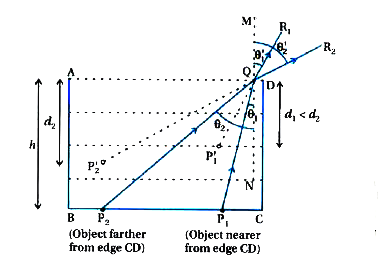
Consider a plane trough (a long and shallow water reservoir with plane bottom) with AD a water surface. Now, observe point like objects `P_1` and `P_2`, at equal depth AB = CD = h obliquely a point Q, nearer to edge CD. Here, for incidence ray `P_1Q`, angle of incidence is `theta_1`. and angle o refraction is `theta._1`. Similarly, for incident ray `vac(P_2Q)` angle of incidence is `theta_2`, and angle of refraction is `theta._2` . Here because of refraction at surface AD of water, we get `theta._1 gt theta_1` and `theta._2 gt theta_2`. Here `theat_2 gt theta_1` and so we get `theta._2 gt theat._1` . Because of this virtual depths of virtual positions `P._1` and `P._2` (of real objects, respectively `P_1` and `P_2`.) are obtained as `d_1` and `d_2` where `d_1 lt d_2` as seen from the figure)
Thus virtual depth is found to be less nearer the edge of trough and farther the edge of trough, it is found to be more.
Now, here if object is an extended object, extended from `P_1` to `P_2` then due to same depth, object is actually planar but when it is observed from near the edge of water surface in a trough image of planar object appears to be distorted. Thus, option (A) is correct.
Now, as per the statement if we consider object in air at `R_1`, near the water surface then its real image is formed at point `P_1`. Here `angleR_1QM = theta._1` and `angleP_1QN = theta_1` where `theta_1 lt theta._1`
`implies` Option (B) is also correct.
Now, in above figure if we shift point-like object towards end B then angle of incidence `theta` goes on increasing. At one stage when `theta ge C` (where C = critical angle), object is not seen from air due to total internal reflection. Thus, option (C) is also correct.
Promotional Banner

Topper's Solved these Questions

  • RAY OPTICS AND OPTICAL INSTRUMENTS

    KUMAR PRAKASHAN|Exercise SECTION-C (NCERT EXEMPLAR SOLUTION) (VERY SHORT ANSWER TYPE QUESITONS)|5 Videos
  • RAY OPTICS AND OPTICAL INSTRUMENTS

    KUMAR PRAKASHAN|Exercise SECTION-C (NCERT EXEMPLAR SOLUTION) (SHORT ANSWER TYPE QUESITONS)|6 Videos
  • RAY OPTICS AND OPTICAL INSTRUMENTS

    KUMAR PRAKASHAN|Exercise SECTION-B (NUMERICALS)(NUMERICAL FROM .DARPAN. BASED ON TEXTBOOK )|12 Videos
  • MOVING CHARGES AND MAGNETISM

    KUMAR PRAKASHAN|Exercise SECTION D (MCQs ASKED IN COMPETITIVE EXAMS)|34 Videos
  • SAMPLE QUESTION PAPER

    KUMAR PRAKASHAN|Exercise PART-B SECTION-C|5 Videos

Similar Questions

Explore conceptually related problems

In an experiment to determine the focal length (f) of a concave mirror by the u-v method, a student places the object pin A on the principal axis at a distance x from the pole P. The student looks at the pin and its inverted image from a distance keeping his/her eye in line with PA. When the student shifts his/her eye towards left, the image appears to the right of the object pin. Then,

The redius of curvature of the convex face of a plano-convex lens is 12cm and its refractive index is 1.5. a. Find the focal length of this lens. The plane surface of the lens is now silvered. b. At what distance form the lans will parallel rays incident on the convex face converge? c. Sketch the ray diagram to locate the image, when a point object is places on the axis 20cm from the lens. d. Calculate the image distance when the object is placed as in (c).

A U-tube of small and uniform cross section contains water of total length 4H the height difference between the water columns on the left and on the right is H when the valve K is closed, the valve is suddenly open, and water is flowing from left to right. ignore friction find the speed of water when the heights of the left and the right water columns are the same.

Consider the situation shown in figure. Water (mu_(W) = (4)/(3)) is filled in a breaker upto a height of 10 cm . A plane mirror fixed at a height of 5 cm from the surface of water. Distance of image from the mirror after reflection from it of an object O at the bottom of the beaker is

An eye can distinguish between two points of an object if they are separated by more than 0.22 mm when the object is placed at 25 cm from the eye. The object is now seen by a compound microscope having a 20 D objective and 10 D eyepiece separated by a distance of 20 cm. The final image is formed at 25 cm from the eye. What is the minimum separation between two points of the object which can now be distinguished?

An object of specific gravity rho is hung from a thin steel wire. The fundamental frequency for transverse standing waves in wire is 300 Hz . The object is immersed in water so that one half of its volume is submerged. The new fundamental frequency in Hz is

A 20cm thick glass slab of refractive index 1.5 is kept in front of a plane mirror. Find the position of the image (relative to mirror) as seen by an observer through the glass slab when a point object is kept in air at a distance of 40 cm from the mirror.

(a) How many anstronomical units (AU) make 1 parsec ? (b) Consider a sunlike star at a distance of 2 parsecs. When it is seen through a telescope with 100 magnification what should be the angular size of the star ? Sun appears to be (1/2) from the earth. Due to atmospheric fluctuations, eye cannot resolve objects smaller than 1 arc minute. (c) Mars has approximately half of the earth's diameter. When it is closest to the earth it is at about 1/2 AU from the earth. Calculate what size it will appear when seen through the same telescope.

Refer to figure the arm PQ of the rectangular conductor is moved from x = 0, outwards. The uniform magnetic field is perpendicular to the plane and extends from x = 0 to x = b and is zero for x gt b. Only the arm PQ possesses substantial resistance r. Consider the situation when the arm PQ is pulled outwards from x = 0 to x = 2b and is then moved back to x = 0 with constant speed v. Obtain expressions for the flux, the induced emf, the force necessary to pull the arm and the power dissipated as Joule heat. Sketch the variation of these quantities with distance.

When an object moves through a fluid, as when a ball falls through air or a glass sphere falls through water te fluid exerts a viscous foce F on the object this force tends to slow the object for a small sphere of radius r moving is given by stoke's law, F_(w)=6pietarv . in this formula eta in the coefficient of viscosity of the fluid which is the proportionality constant that determines how much tangential force is required to move a fluid layer at a constant speed v, when the layer has an area A and is located a perpendicular distance z from and immobile surface. the magnitude of the force is given by F=etaAv//z . For a viscous fluid to move from location 2 to location 1 along 2 must exceed that at location 1, poiseuilles's law given the volumes flow rate Q that results from such a pressure difference P_(2)-P_(1) . The flow rate of expressed by the formula Q=(piR^(4)(P_(2)-P_(1)))/(8etaL) poiseuille's law remains valid as long as the fluid flow is laminar. For a sfficiently high speed however the flow becomes turbulent flow is laminar as long as the reynolds number is less than approximately 2000. This number is given by the formula R_(e)=(2overline(v)rhoR)/(eta) In which overline(v) is the average speed rho is the density eta is the coefficient of viscosity of the fluid and R is the radius of the pipe. Take the density of water to be rho=1000kg//m^(3) Q. What is the viscous force on a glass sphere of radius r=1mm falling through water (eta=1xx10^(-3)Pa-s) when the sphere has speed of 3m/s?

KUMAR PRAKASHAN-RAY OPTICS AND OPTICAL INSTRUMENTS-SECTION-C (NCERT EXEMPLAR SOLUTION) (MULTIPLE CHOICE QUESTIONS (MCQs))
  1. A ray of light incident at an angle theta on a refracting face of a pr...

    Text Solution

    |

  2. A short pulse of white light is incident from air to a glass slab at n...

    Text Solution

    |

  3. An object approaches a convergent lens from the left of the lens with ...

    Text Solution

    |

  4. A passenger in an aeroplane shall

    Text Solution

    |

  5. You are given four sources of light each on providing a light of a sin...

    Text Solution

    |

  6. The radius of curvature of the curved surface of a plano-convex lens i...

    Text Solution

    |

  7. The phenomena involved in the reflection of radiowaves by ionosphere i...

    Text Solution

    |

  8. The direction of ray of light incident on a concave mirror is shown by...

    Text Solution

    |

  9. The optical density of turpentine is higher than that of water while i...

    Text Solution

    |

  10. A car is moving with at a constant speed of 60 km h^(-1) on a straight...

    Text Solution

    |

  11. There are certain material developed in laboratories which have a nega...

    Text Solution

    |

  12. Consider an extended object immersed in water contained in a plane tro...

    Text Solution

    |

  13. A rectangular block of glass ABCD has a refractive index 1.6. A pin is...

    Text Solution

    |

  14. Between the primary and secondary rainbows, there is a dark band known...

    Text Solution

    |

  15. A magnifying glass is used, as the object to be viewed can be brought ...

    Text Solution

    |

  16. An astronomical refractive telescope has an objective of focal length ...

    Text Solution

    |

