Home
Class 12
PHYSICS
A magnifying glass is used, as the objec...

A magnifying glass is used, as the object to be viewed can be brought closer to the eye than the normal near point. This results in

A

a larger angle to be subtended by the object at the eye and hence viewed in greater detail.

B

the formation of a virtual erect image.

C

increase in the field of view.

D

infinite magnification at the near point.

Text Solution

Verified by Experts

The correct Answer is:
A, B


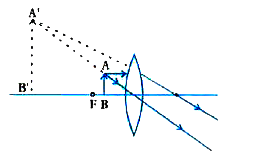
As shown in the figure, while using convex lens as a magnifying glass, object is placed very close to principal focus but inside it. By doing so, angle made by object at the eye is obtained large and so we can have more angular magnification. Thus, option (A) is correct.
According to above ray diagram, we obtain image A.B. which is virtual, errect and magnified. Thus option (B) is also correct.
Promotional Banner

Topper's Solved these Questions

  • RAY OPTICS AND OPTICAL INSTRUMENTS

    KUMAR PRAKASHAN|Exercise SECTION-C (NCERT EXEMPLAR SOLUTION) (VERY SHORT ANSWER TYPE QUESITONS)|5 Videos
  • RAY OPTICS AND OPTICAL INSTRUMENTS

    KUMAR PRAKASHAN|Exercise SECTION-C (NCERT EXEMPLAR SOLUTION) (SHORT ANSWER TYPE QUESITONS)|6 Videos
  • RAY OPTICS AND OPTICAL INSTRUMENTS

    KUMAR PRAKASHAN|Exercise SECTION-B (NUMERICALS)(NUMERICAL FROM .DARPAN. BASED ON TEXTBOOK )|12 Videos
  • MOVING CHARGES AND MAGNETISM

    KUMAR PRAKASHAN|Exercise SECTION D (MCQs ASKED IN COMPETITIVE EXAMS)|34 Videos
  • SAMPLE QUESTION PAPER

    KUMAR PRAKASHAN|Exercise PART-B SECTION-C|5 Videos

Similar Questions

Explore conceptually related problems

A man with normal near point (25 cm) reads a book with small print using a magnifying glass : a thin convex lens of focal length 5 cm . (a) What are the closest and the farthest distances at which he can read the book when viewing through the magnifying glass ? (b) What is the maximum and the minimum angular magnifications (magnifying powers) possible using the above simple microscope ?

Answer the following questions: (b) In viewing through a magnifying glass, one usually positions one’s eyes very close to the lens. Does angular magnification change if the eye is moved back?

A card sheet divided into squares each of size 1 mm^(2) is being viewed at a distance of 9 cm through a magnifying glass (a converging lens of focal length 10 cm) held close to the eye. (a) What is the magnification produced by the lens? How much is the area of each square in the virtual image? (b) What is the angular magnification (magnifying power) of the lens? (c) Is the magnification in (a) equal to the magnifying power in (b)? Explain.

For normal eye vision what is the object distance and image-distance when the object is placed at a near point? (Take the distance between the eye lens and the retina as 2.3 cm.)

The far point of a myopic eye is 100 cm. What is the focal length of the lens required to see very distant (normal far point) objects clearly?

Answer the following questions: (a) The angle subtended at the eye by an object is equal to the angle subtended at the eye by the virtual image produced by a magnifying glass. In what sense then does a magnifying glass provide angular magnification?

What is the far point and near point of the human eye with normal vision ?

A small telescope has an objective lens of focal length 140cm and an eyepiece of focal length 5.0cm. What is the magnifying power of the telescope for viewing distant objects when (a) the telescope is in normal adjustment (i.e., when the final image is at infinity)? (b) the final image is formed at the least distance of distinct vision (25cm)?

In YDSE if a slab whose refractive index can be varied is placed in front of one of the slits. Then, the variation of resultant intensity at mid-point of screen with mu will be best represented by (mu is greater than or equal to 1)

KUMAR PRAKASHAN-RAY OPTICS AND OPTICAL INSTRUMENTS-SECTION-C (NCERT EXEMPLAR SOLUTION) (MULTIPLE CHOICE QUESTIONS (MCQs))
  1. A ray of light incident at an angle theta on a refracting face of a pr...

    Text Solution

    |

  2. A short pulse of white light is incident from air to a glass slab at n...

    Text Solution

    |

  3. An object approaches a convergent lens from the left of the lens with ...

    Text Solution

    |

  4. A passenger in an aeroplane shall

    Text Solution

    |

  5. You are given four sources of light each on providing a light of a sin...

    Text Solution

    |

  6. The radius of curvature of the curved surface of a plano-convex lens i...

    Text Solution

    |

  7. The phenomena involved in the reflection of radiowaves by ionosphere i...

    Text Solution

    |

  8. The direction of ray of light incident on a concave mirror is shown by...

    Text Solution

    |

  9. The optical density of turpentine is higher than that of water while i...

    Text Solution

    |

  10. A car is moving with at a constant speed of 60 km h^(-1) on a straight...

    Text Solution

    |

  11. There are certain material developed in laboratories which have a nega...

    Text Solution

    |

  12. Consider an extended object immersed in water contained in a plane tro...

    Text Solution

    |

  13. A rectangular block of glass ABCD has a refractive index 1.6. A pin is...

    Text Solution

    |

  14. Between the primary and secondary rainbows, there is a dark band known...

    Text Solution

    |

  15. A magnifying glass is used, as the object to be viewed can be brought ...

    Text Solution

    |

  16. An astronomical refractive telescope has an objective of focal length ...

    Text Solution

    |

