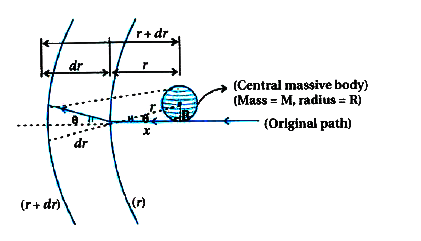
`rArr` As shown in the figure , when light ray passes tangentially to the surface of central massive body of mass M and radius R , suppose it gets deviated by amount `d theta` within distacen dr.
`rArr` Now, applying Snell.s law at the point where light ray is made incident on the concentric spherical suface at distance, r, from the centre of central massive body we get ,
`n sin theta = (n + dn) sin ( theta + d theta)`
`therefore n sin theta = (n + dn) (sin theta cos d theta + cos theta sin d theta)`
`therefore n sin theta = n sin theta cos ( d theta) + n cos (d theta) + n cos theta sin (d theta) + (dn) sin theta cos (d theta) + (dn) cos theta sin (d theta)`
`rArr` Since ` dtheta` is extremely small, we can take `sin (d theta ) = (d theta)`
and taking `cos (theta) = `
`n sin theta =n sin theta + n cos theta (d theta) + (dh) sin theta + (dn ) cos theta (d theta)`
`therefore 0 = n cos theta ( because (dn)(cos theta) (dtheta ` is negligible)
`therefore - (dn) sin theta = n cos theta (d theta)`
` therefore - ((dn)/(dr)) sin theta = n cos theta ((d theta)/(dr))`
`therefore - ((dn)/(dr)) tan theta = n ((d theta)/(dr))`.....(1)
`rArr` From the statement ,
`n = 1 + (2GM)/(rc^2)`
`therefore (dn)/(dr) = 0 + (2GM)/(c^2) (-(1)/(r^2)) [ because (d)/(dr)(1/r)= - (1)/(r^2)]`
`therefore (dn)/(dr) = 0 + (2GM)/(r^2c^2)` ......(2)
`rArr` From equation (1) and (2) ,
`(2GM)/(r^2c^2) tan theta = (1 + (2GM)/(rc^2))(d theta)/(dr)`
`rArr` Here inside the backet on R.H.S
`(2GM)/(rc^2) lt lt lt lt 1` and so neglecing it,
`(2 GM)/(r^2 c^2) tan theta = (d theta)/(dr)`
`therefore d theta = (2GM)/(c^2) ((tan theta)/(r^2))dr ....... (3)`
`rArr` From the figure `r^2= x^2 + R^2` .......(4)
`therefore 2r dr = 2x dx + 0`
`therefore r dr = x dx rArr dr = (xdx)/(r)` ......(5)
`rArr` From equations (3) and (5),
`d theta = (2GM)/(c^2) (tan theta)/(r^3) x dx ......(7)`
`rArr` Here,
`r^2 = x^2 + R^2`
`therefore (r^2)^(3//2) = (x^2 + R^2)^(3//2)`
`therefore r^3 = (x^2 +R^2)^(3//2)` ......(8)
`rArr` From equaitons (6),(7) and (8),
`d theta = (2GM)/(c^2) (R)/(x^2 + R^2)^(3//2)dx .....(9)`
`rArr` Now suppose,
`x = R tan theta phi`
`therefore dx = R sec^2 phi d phi` .......(11)
`rArr` Now,
`(x^2 + R^2)^(3//2) = (R^2 tan^2 phi + R^(2))^(3//2)`
`= (R^2 sec^2 phi )^(3//2)`
` = R^3 sec^3 phi` ........(12)
`rArr` From equaitons (9),(11),(12),
`d theta = (2GM)/(Rc^2) cos phi " d " phi`.......(13)
`rArr` From equation (10), if
` x= - oo " then " phi = - (pi)/(2)` rad
`x = + oo` then `phi = l (pi)/(2)` rad
`rArr` Also when ` x = - oo, theta = 0`
`x = + oo, theta - theta_0`
Taking intergration on both the sides of eqation (13),
`int_(0)^(theta0) d theta = (2GM)/(Rc^2) int_(-pi/2)^(+pi/2) cos theta " d "theta`
`therefore theta_0 = (2GM)/(Rc^2){sin phi}_(-pi/2)^(+pi/2)`
` = (2GM)/(Rc^2){sin (pi/2) - sin (- pi/2)}`
`therefore theta_0 = (4GM)/(Rc^2)`
`rArr` Above equation gives required result.


