Home
Class 12
PHYSICS
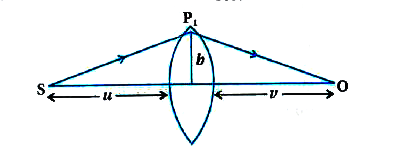
Consider a thin lens placed between a so...


Consider a thin lens placed between a source (S) and an observer (O) (see figure) . Let the thicknes of the lens very as `w(b) = w_0 - (b^2)/(alpha)`,
where b is the verticle distance from the pole.
`w_0` is constant. Using Fermat.s principle i.e. the time of transit for a ray between the source and observer is an extremum, find the condition that all paraxial rays starting from the source will converage at a point O on the axis. Find the focal length.
(ii) A gravitational lens may be assumed to have a varying width of the from
`w(b) = k_1 "ln" ((k_2)/(b)) b_("min") lt b lt b_("max")`
`= k_1 "ln" ((k_2)/(b_"min")) b lt b_("min")`
Show that an observe will see an image of a point object as a right about the center of the lens with and angular radius
`beta=sqrt(((n-1)k_1(u)/(v))/(u+v))`

Text Solution

Verified by Experts

`rArr` (i) Time taken by light ray to travel from S to `P_1`
`t_1 = (SP_1)/(c) = ((u^2+b^2)^(1//2))/(c) = ({u^2(1+b^2/u^2)}^(1/2))/(c)`
`therefore t_1 = u/c(1+ b^2/u^2)^(1/2)`
`rArr` Here `(b^2)/(u^2) lt lt 1` and so expanding according to binomial theorem and then retaining only first two terms,
`t_1 ~~ u/c (1+(b^2)/(2u^2))` .......(1)
`rArr` Similarly, time taken by light ray to travel from `P_1` to O,
`t_2 = (P_1O)/(c) = ((v^2 + b^2)^(1/2))/(c) = ({v^2(1+ b^2/v^2)}^(1/2))/(c)`
`therefore t_2 = v/c (1+(b^2)/(v^2))^(1/2)`
`rArr` Here `(b^2)/(b^2) lt lt 1` and so expanding according to binomial theorem and then rataining only first two terms ,
`t_(2) = v/c (1 + (b^2)/(2v^2))`.......(2)
`rArr` Now time taken by light ray to travel trough thickness W of a lens at point `P_1`
`t_(2) = v/c (1 + (b^2)/(2v^2))`
`rArr` Now time taken by light ray to travel trough thickness W of a lesns at point `P_1`
`t_3 = ((n-1)W)/(c)`
(As per statement `W = W_0 - (b^2)/(alpha))`......(3)
`rArr` Now, total time taken by light ray to travel from S to `P_1` to O is t then,
`t = t_1 + t_2+t_3`
`therefore t = u/c (1 + (b^2)/(2b^2))+v/c(1+(b^2)/(2v^2)) +((n-1)W)/(c)`
`therefore t = 1/c (u + (b^2)/(2u))+1/c(v+b^2/(2v))+1/c(n-1)W`
`therefore t 1/c [ u+v+(b^2)/(2)(1/u +1/v)+(n-1)W]`
`rArr` Here, for the sake of simplicity, if we assume
`1/u + 1/v = 1/D` then ......(4)
`t = 1/c[u +v + (b^2)/(2D) +(n-1)W].....(5)`
`therefore t =1 /c[u+v+(b^2)/(2D)+(n-1)(w_0 - (b^2)/(alpha))]....(6)`
As per statement
`therefore (dt)/(db) = 1/c[0+0+1/2(2b)+(n-1)(0-1/alpha xx 2b)]`
`therefore (dt)/(db) = 1/c[b/D - (2b)/(alpha)(n-1)]`........(7)
`rArr` Now , according to Farmar.s principle above time t is either maximum or mimum and so its first derivative with respect to variable b should be zero.
`(dt)/(db) = 0`
`therefore 1/c[b/c - (2b)/(alpha)(n-1)] =0`
`therefore b/D = (2b)/(alpha) (n-1)`
`alpha = 2 (n-1)D`.....(8)
`rArr` Above equation gives required condition.
Here, value of `alpha` is independent of b. Hence for the case when `b lt lt u`, all paraxial rays, incident on the lens, will be focused at point O.
(ii) Now, for given gravitational lens,
`W= K_1 "log"((K_2)/(b))` (As per statement ) ....(9)
`rArr` From equation (5) and (9).
`t = 1/c[u+v = (b)/(2D)+(n-1) K_1 "log"((K_2)/(b))]`
`therefore t = 1/c[u+v+(b^2)/(2D) + (n-1)K_1{logK_2-logb}]`
`therefore (dt)/(db) = 1/c[0+0 + (1)/(2D) (2b)+(n-1)K_1{0-1/b}]`
`therefore (dt)/(db)=1/c[b/d-((n-1)K_1)/(b)]`........10
`rArr` Now, according to Farmat.s principle we
have `(dt)/(db) = 0`
` b/D = ((n-1)K_1)/(b)`
`therefore b = (n-1)K_1D`
`therefore b = sqrt((n-1)K_1D)`.......(11)
`rArr` Thus, those light rays which are incident on the lens at above height from S, contribute in the formation of image. Such image is having shape of a circular ring . If its angular radius is `beta` then ,
`Beta = ("arc")/("radius")`
`therefore beta = = (b)/(b)`
`= sqrt((n-1)K_1D)/(b)`
`= sqrt(((n-1)K_1)/(v^2) xx (uv)/(u+v)`)
`( therefore" From equation (4) D " = (uv)/(u+v))`
`therefore beta = sqrt(((n-)K_u)/(v(u+v)))" ".......(12)`
`rArr` Above equation gives required result.
Promotional Banner

Topper's Solved these Questions

  • RAY OPTICS AND OPTICAL INSTRUMENTS

    KUMAR PRAKASHAN|Exercise SECTION-D (MULTIPLE CHOICE QUESTIONS (MCQs))(MCQs FROM .DARPAN. BASED ON TEXTBOOK)|26 Videos
  • RAY OPTICS AND OPTICAL INSTRUMENTS

    KUMAR PRAKASHAN|Exercise SECTION-D (MULTIPLE CHOICE QUESTIONS (MCQs))(MCQs FROM .DARPAN. BASED ON TEXTBOOK)(REFRACTION)|32 Videos
  • RAY OPTICS AND OPTICAL INSTRUMENTS

    KUMAR PRAKASHAN|Exercise SECTION-C (NCERT EXEMPLAR SOLUTION) (SHORT ANSWER TYPE QUESITONS)|6 Videos
  • MOVING CHARGES AND MAGNETISM

    KUMAR PRAKASHAN|Exercise SECTION D (MCQs ASKED IN COMPETITIVE EXAMS)|34 Videos
  • SAMPLE QUESTION PAPER

    KUMAR PRAKASHAN|Exercise PART-B SECTION-C|5 Videos

Similar Questions

Explore conceptually related problems

Give difference between w and w^(2)

Write source of ultraviolet rays and uses.

Write source and uses of X - rays.

V_(radial) is considered…….when the source moves away from the observer.

If w=alpha+ibeta where beta ne 0 and z ne 1 satisfies the condition that ((w- bar wz)/(1-z)) is purely real then the set of values of z is

A light ray hits the pole of a thin biconvex lens as shown in fig. The angle made by the emergent ray with the optic axis will be approximately

In a given circuit, equivalent resistance between A and B = Omega .

Let’s find the distance between two points A(4, 3) and B(8, 6)

A mirror and a source of light are situated at the origin O and at a point on O X , respectively. A ray of light from the source strikes the mirror and is reflected. If the direction ratios of the normal to the plane are 1,-1,1, then find the D C s of the reflected ray.
