Home
Class 12
PHYSICS
Focal lengths of objective and eye-piece...

Focal lengths of objective and eye-piece of microscope is 1.6 cm and 2.5 cm respectively. Distance between two lenses is 21.7 cm. If final image is formed at infinity, then magnification m = ......

A

11

B

110

C

1.1

D

44

Text Solution

Verified by Experts

The correct Answer is:
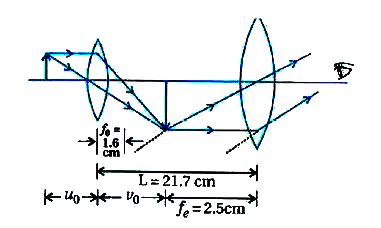
A, B

`v_0=L-f_e=21.7-2.5=+19.2` cm

For objective `(1)/(v_0)-(1)/(u_0)=(1)/(f_0)`
`therefore (-1)/(u_0)=(1)/(f_0)-(1)/(v_0)`
`therefore (-1)/(u_0) =(19.2-1.6)/((1.6)(19.2))`
`therefore u_0=-1.745`cm
When image is formed at infinity magnification
`m=((v_0)/(u_0))((D)/(f_e))` where D=25 cm
`=((19.2)/(1.745))((25)/(2.5))`
`therefore m=110` cm
Promotional Banner

Topper's Solved these Questions

  • RAY OPTICS AND OPTICAL INSTRUMENTS

    KUMAR PRAKASHAN|Exercise SECTION-D (MULTIPLE CHOICE QUESTIONS (MCQs))(MCQs FROM .DARPAN. BASED ON TEXTBOOK)(MCQs BASED ON TEXTUAL ILLUSTRATION AND EXERCISE)|24 Videos
  • MOVING CHARGES AND MAGNETISM

    KUMAR PRAKASHAN|Exercise SECTION D (MCQs ASKED IN COMPETITIVE EXAMS)|34 Videos
  • SAMPLE QUESTION PAPER

    KUMAR PRAKASHAN|Exercise PART-B SECTION-C|5 Videos

Similar Questions

Explore conceptually related problems

Focal lenghts of objective and eye-piece of telescope 200 cm and 2 cm respectively. If a building of 50 m height at 2 km away is observed from this, then height of image of objective will be ......

A compound microscope has an objective of focal length 2.0 cm and an eye-piece of focal length 6.25cm and distance between the objective and eye-piece is 15cm . If the final image is formed at the least distance vision (25 cm) , the distance of the object form the objective is

Distance between divergent lens and object is m times than focal length. Linear magnification of lens is ......

The focal length of objective and eye lens of a astronomical telescope are respectively 2m and 5 cm . Final image is formed at (i) least distance of distinct vision (ii) infinity. The magnifying power in both cases will be

A astronomical telescope has objective and eyepiece of focal length 40 cm and 4 cm respectively. To view an object 200 cm away from the objective, the lenses must be separated by a distance

An eye can distinguish between two points of an object if they are separated by more than 0.22 mm when the object is placed at 25 cm from the eye. The object is now seen by a compound microscope having a 20 D objective and 10 D eyepiece separated by a distance of 20 cm. The final image is formed at 25 cm from the eye. What is the minimum separation between two points of the object which can now be distinguished?

A point object is placed at a diatance of 25 cm from a convex lens of focal length 20 cm. If a glass slab of thickness t and refractive index 1.5 is inserted between the lens and the object, the image is formed at infinity. The thickness t is

If f_0 and f_e , are respective focal lengths of objective and eye-piece of compound microscope, then ......

KUMAR PRAKASHAN-RAY OPTICS AND OPTICAL INSTRUMENTS-SECTION-D (MULTIPLE CHOICE QUESTIONS (MCQs))(MCQs ASKED IN COMPETITIVE EXAMS)
  1. Aperture of lens of a camera is f and its exposure time is (1)/(60) s....

    Text Solution

    |

  2. Intensity of point-like source at 1000 m is I. it is changed to 16I, t...

    Text Solution

    |

  3. Focal lengths of objective and eye-piece of microscope is 1.6 cm and 2...

    Text Solution

    |

  4. Power of a convex lens of refractive index 3/2 is 2.5 D in air. If it ...

    Text Solution

    |

  5. The surface which doesn.t reflect is given incidence light with 18 W//...

    Text Solution

    |

  6. For concave mirror, image obtained at d2 from focus for object at d1 f...

    Text Solution

    |

  7. Object of small length 1 is placed on the axis of concave mirror of fo...

    Text Solution

    |

  8. Two lenses of focal lengths -20 cm and + 10 cm are conneceted to form ...

    Text Solution

    |

  9. A: Stars twinkle in sky at night, planets don.t. R: Volume of star...

    Text Solution

    |

  10. A: Owl can move easily at night time. R : There are so many rods i...

    Text Solution

    |

  11. A: Red substance seems to be black in presence of yellow light. R:...

    Text Solution

    |

  12. A: Transperency of glass decreases if its surface becomes rough. R...

    Text Solution

    |

  13. A: Diamond glitters. R: Diamond doesn.t absorb sun light.

    Text Solution

    |

  14. A: Resolution of telescope is high if diameter of objective is large. ...

    Text Solution

    |

  15. A: Power of lens of goggles is zero. R: Radii of curvature of both...

    Text Solution

    |

  16. A: If objective and eye-piece of compoun microcscope are interchanged,...

    Text Solution

    |

  17. A: When white light passes through lens then refraction of violet ligh...

    Text Solution

    |

  18. A: Magnified image is obtained by microscope. R: Angular dispersio...

    Text Solution

    |

  19. A: Magnification for convex mirror is always positive where it may be ...

    Text Solution

    |

  20. A spherical mirror gives real image 3 times greater than object. If di...

    Text Solution

    |

