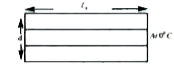
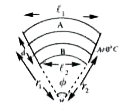
Let A and B be two straight strips fastened parallel to each other at `0^(@)C`. When heated to `t^(@)C` the strips of different metals expand differently. So, the bimetallic strip bends. The radius of curvature of strip A is `r_(1)` and that of B is `r_(2)`.
If `l_(0)` is the original length of the metal strips at `0^(@)Candl_(1),l_(2)` are the lengths of strips A, B respectively at `t^(@)C`, then `l_(1)=l_(0)(1+alpha_(1)t)andl_(2)=l_(0)(1+alpha_(2)t)" "...(i)`
Where `alpha_(1)andalpha_(2)` are the coefficient of linear expansion of strips A and B respectively.
If `phi` is the angle subtended by the bent strips at their common centre of curvature O and `r_(1),r_(2)` are the radii of curvature of strips A, B respectively, then
`l_(1)=r_(1)phiandl_(2)=r_(2)phi" ".....(ii)`
Substituting `l_(1)andl_(2)` from equation (i)
`l_(0)(1+alpha_(1)t)=r_(1)phiandl_(0)(1+alpha_(2)t)=r_(2)phi`
`(r_(1)-r_(2))phi=l_(0)(alpha_(1)-alpha_(2))t`
`phi=(l_(0)(alpha_(1)-alpha_(2))t)/((r_(1)-r_(2)))=(l_(0)(alpha_(1)-alpha_(2))t)/d" "(thereforer_(1)-r_(2)=d)`
`l_(0)(1+alpha_(1)t)=r_(1)phiandl_(0)(1+alpha_(2)t)=r_(2)phi`
Adding
`l_(0)(1+alpha_(1)t+1+alpha_(2)t)=(r_(1)+r_(2))phi`
`l_(0)(2+(alpha_(1)+alpha_(2))t)=(r_(1)+r_(2))(l_(0)(alpha_(1)-alpha_(2)))/d`
`2=(r_(1)+r_(2))((alpha_(1)-alpha_(2))t)/d`
`because(alpha_(1)+alpha_(2))t` is neglected when compared with 2
`(r_(1)+r_(2))/2=d/((alpha_(1)-alpha_(2))t)`
`(r_(1)+r_(2))/2` is the average radius of curvature of the bimetallic strip when heated. It is denoted by r.
`r=d/((alpha_(1)-alpha_(2))t)`
when the bimetallic strip is cooled by `t^(@)C`, it bends in opposite direction with the same average radius of curvature.


