Two containers of equal volume contain the same gas at pressures `P_(1)andP_(2)` and absolute temperatures `T_(1)andT_(2)` respectively. On joining the vessels, the gas reaches a common pressure P and a common temperature T. Find the value P/T.
Text Solution
Verified by Experts
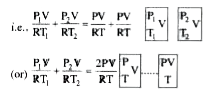
Number of moles before joining = Number of moles after joining the vessels. `n_(1)+n_(2)=n_(1)^(1)+n_(2)^(1)` `rArrP_(1)/T_(1)+P_(2)/T_(2)=(2P)/T" "thereforeP/T=1/2[P_(1)/T_(1)+P_(2)/T_(2)]`
Topper's Solved these Questions
THERMAL PROPERTIES OF MATTER
AAKASH SERIES|Exercise EXERCISE-IA|217 Videos
THERMAL PROPERTIES OF MATTER
AAKASH SERIES|Exercise EXERCISE-IB|68 Videos
SYSTEM OF PARTICLES AND ROTATIONAL MOTION
AAKASH SERIES|Exercise PRACTICE EXERCISE|99 Videos
THERMODYNAMICS
AAKASH SERIES|Exercise EXERCISE - 3|33 Videos
Similar Questions
Explore conceptually related problems
Two containers, each of volume V_(0) , joined by a small pipe initially contain the same gas at pressure P_(0) and at absolute temperature T_(0) . One container is now maintained at the same temperature while the other is heated to 2T_(0) . Find(1) commom pressure of the gas, and(2) the number of moles of gas in the container at temperature 2T_(0)
Two containers, each of volume V_0 , joined by a small pipe initially contain the same gas at pressure P_0 and at absolute temperature T_0 . One container is now maintained at the same temperature while the other is heated to 2 T_0 . If the number of moles of gas in the container at temperature 2T_0 is (nP_0 V_0)/( 3 RT_0) then 'n' is
An ideal gas in a thermally insulated vessel at internal pressure = P_(4) , volume = V_(1) and absolute temperature = T_(1) expands irreversibly against zero external pressure, as shown in the diagram. The final internal pressure, volume and absolute temperature of the gas are P_(2), V_(2) and T_(2) , respectively. For this expansion.
The velocities of sound in an ideal gas at temperature T_(1) and T_(2) K are found to be V_(1) and V_(2) respectively. If ther.m.s velocities of the molecules of the same gas at the same temperatures T_(1) and T_(2) are v_(1) and v_(2) respectively then
AAKASH SERIES-THERMAL PROPERTIES OF MATTER-ADDITIONAL PRACTICE EXERCISE (LEVEL - II) PRACTICE SHEET (ADVANCED) Integer/Subjective Type Questions