Text Solution
Verified by Experts



Topper's Solved these Questions
ALKYL AND ARYL HALIDES
AAKASH SERIES|Exercise SUBJECTIVE EXERCISE - 1 (SHORT ANSWER QUESTIONS)|6 VideosALKYL AND ARYL HALIDES
AAKASH SERIES|Exercise SUBJECTIVE EXERCISE - 1 (VERY SHORT ANSWER QUESTIONS)|1 VideosALKYL AND ARYL HALIDES
AAKASH SERIES|Exercise Exercise-1.2|34 VideosALDEHYDES AND KETONES
AAKASH SERIES|Exercise Exercise 3.2|41 VideosAMINES AND AZO COMPOUNDS
AAKASH SERIES|Exercise PRACTICE SHEET - 6 (Integer answer type Questions)|9 Videos
Similar Questions
Explore conceptually related problems
AAKASH SERIES-ALKYL AND ARYL HALIDES-EXAMPLES
- R-Cl is hydrolysed to R-OH slowly but the reaction is rapid in presenc...
Text Solution
|
- Optically active 2-iodobutane on treatment with sodium iodide in aceto...
Text Solution
|
- Expain the formation of the two products in the following reaction : ...
Text Solution
|
- Why the chlorine atom in vinyl chloride is nonreactive?
Text Solution
|
- Allyl iodide can be obtained from allyl chloride. Explain.
Text Solution
|
- Predict the order of reactivity of the following compounds in SN1 and ...
Text Solution
|
- Write the structures of major and minor products formed when 3-chloro-...
Text Solution
|
- How do you distinguish between CH3CH = CHCl , CH3CH2Cl and CH2=CH-CH2C...
Text Solution
|
- In the following pairs of halogen compounds, which would undergo SN2 r...
Text Solution
|
- Predict the order of reactivity of the following compounds in SN1 and ...
Text Solution
|
- Which alkyl halide from the following pairs would you expect to react ...
Text Solution
|
- In the following pairs of halogen compounds, which compound undergoes ...
Text Solution
|
- Identify A, B, C, D, E, R and R' in the following:
Text Solution
|
- What is teflon ? How is it prepared ?
Text Solution
|
- How will you distinguish between chloroform and carbon tetrachloride ?
Text Solution
|
- How iodoform is distinguished from chloroform?
Text Solution
|
- Among the three isomeric dichlorobenzenes , which has the highest...
Text Solution
|
- Which product will form when optically active form of C4H9Br is subje...
Text Solution
|
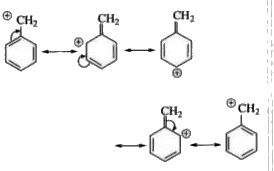
- Benzyl chloride undergoes nucleophilic substitution much more easily t...
Text Solution
|
- Nucleophilic substitution in aryl halides is facilitated by electron w...
Text Solution
|