Home
Class 9
PHYSICS
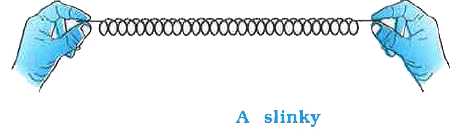
Take a slinky as shown below. Ask a fr...

Take a slinky as shown below.
Ask a friend to hold one of its ends. You hold the other end and move away from your friend. Now you release the slinky.

How did the slinky acquire energy when stretched?

Text Solution

Verified by Experts

When the slinky is stretched, it acquired energy due to work done on it during stretching.
Promotional Banner

Topper's Solved these Questions

  • WORK AND ENERGY

    KUMAR PRAKASHAN|Exercise ACTIVITY 11.10|6 Videos
  • WORK AND ENERGY

    KUMAR PRAKASHAN|Exercise ACTIVITY 11.13|10 Videos
  • WORK AND ENERGY

    KUMAR PRAKASHAN|Exercise ACTIVITY 11.4|4 Videos
  • SOUND

    KUMAR PRAKASHAN|Exercise QUESTIONS AND ANSWERS (Additional numericals for practice)|16 Videos

Similar Questions

Explore conceptually related problems

Take a slinky as shown below. Ask a friend to hold one of its ends. You hold the other end and move away from your friend. Now you release the slinky. What happened?

Take a slinky as shown below. Ask a friend to hold one of its ends. You hold the other end and move away from your friend. Now you release the slinky. Would the slinky acquire energy when it is compressed?

By the term velocity of rain, we mean velocity with which raindrops fall relative to the ground. In absence of wind, raindrops fall vertically and in presence of wind raindrops fall obliqucly. Moreover raindrops acquire a constant terminal velocity due air resistance very quickly as they fall toward the carth. A moving man relative to himself observes an altered velocity of raindrops. Which is known as velocity of rain relative to the man. It is given by the following equation. vec(v)_(rm)=vec(v)_(r)-vec(v)_(m) A standstill man relative to himself observes rain falling with velocity, which is equal to velocity of the raindrops relative to the ground. To protect himself a man should his umbrella against velocity of raindrops relative to himself as shown in the following figure. When you are standstill in rain, you have to hold umbrella vertically to protect yourself. (a) When you walk with velocity 90 cm/s, you have to hold your umbrella at 53^(@) above the horizontal. What is velocity of the raindrops relative to the ground and relative to you ? (b) If you walk with speed 160 cm/s, how should you hold your umbrella ?

An experimental setup of verification of photoelectric effect is shown in the diagram. The voltage across the electrode is measured with the help of an ideal voltmetar, and which can be varied by moving jockey 'J' on the potentiometer wire. The battery used in potentiometer circuit is of 20 V and its internal resistance is 2omega . The resistance of 100 cm long potentiometer wire is 8 omega . The photo current is measured with the help of an ideal ammeter. Two plates of potassium oxide of area 50 cm^(2) at separation 0.5 mm are used in the vacuum tube. Photo current in the circuit is very small so we can treat potentiometer circuit an indepdent circuit. The wavelength of various colours is as follows : |{:("Light",underset("Violet")(1),underset("Blue")(2),underset("Green")(3),underset("Yellow")(4),underset("Orange")(5),underset("Red")(6)),(lambda "in" Årarr,4000-4500,4500-5000,5000-5500,5500-6000,6000-6500,6500-7000):}| When other light falls on the anode plate the ammeter reading remains zero till, jockey till, jockey is moved from the end P to the middle point on the wire PQ. Thereafter the deflection is recorded in the ammeter. The maximum kinetic energy of the emitted electron is :
