Home
Class 9
PHYSICS
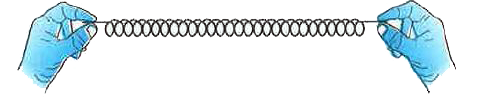
Take a slinky as shown below. Ask a fr...

Take a slinky as shown below.
Ask a friend to hold one of its ends. You hold the other end and move away from your friend. Now you release the slinky.

Would the slinky acquire energy when it is compressed?

Text Solution

Verified by Experts

Yes. To compress the slinky, work has to be done which is stored in the slinky as potential energy.
Promotional Banner

Topper's Solved these Questions

  • WORK AND ENERGY

    KUMAR PRAKASHAN|Exercise ACTIVITY 11.10|6 Videos
  • WORK AND ENERGY

    KUMAR PRAKASHAN|Exercise ACTIVITY 11.13|10 Videos
  • WORK AND ENERGY

    KUMAR PRAKASHAN|Exercise ACTIVITY 11.4|4 Videos
  • SOUND

    KUMAR PRAKASHAN|Exercise QUESTIONS AND ANSWERS (Additional numericals for practice)|16 Videos

Similar Questions

Explore conceptually related problems

Take a slinky as shown below. Ask a friend to hold one of its ends. You hold the other end and move away from your friend. Now you release the slinky. What happened?

Take a slinky as shown below. Ask a friend to hold one of its ends. You hold the other end and move away from your friend. Now you release the slinky. How did the slinky acquire energy when stretched?

When a situation demands our immediate action, it takes some time before we really respond. Reaction time is the time a person takes to observe, think and act. For example, if a person is driving and suddenly a boy appears on the road, then the time elapsed before he slams the brakes of the car is the reaction time. Reaction time depends on complexity of the situation and on an individual. You can measure your reaction time by a simple experiment. Take a ruler and ask your friend to drop it vertically through the gap between your thumb and forefinger . After you catch it, find the distance d travelled by the ruler. In a particular case, d was found to be 21.0 cm. Estimate reaction time.

A block of mss m is placed on a level frictionless table. The block is attached to a horizontally aligned spring fixed with its other end and is vibrating in a horizontal with the pariod T . Suddenly at the instant of time when the spring comes to the position of euilibrium and becomes unstretched the block disconnects form the spring and continues sliding across the frictionless surface away from the until it encounters loop of radius R . What must be the amplitude of vibrations of the block s on the spring in order for the block to complets one loop without falling down?
