Home
Class 11
PHYSICS
A ball moving with a velocity of 6 m/s s...

A ball moving with a velocity of 6 m/s strikes an identical stationary ball. After collisions each ball moves at an angle of `30^(@)` with the original line of motion. What are the speeds of the balls after the collision?

Text Solution

Verified by Experts
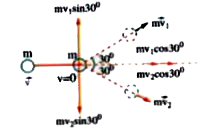

Applying the law of conservation of momentum perpendicular to the initial line of motion:
`0 = mv _(1) sin 30^(@) - mv _(2) sin 30^(@) or v _(1) =v _(2) …(i)`
Hence speed of both will be same after collision. Now along the line of motion:
`mv = mv _(1) cos 30^(@) + mv _(2) cos 30^(@).....(ii)`
Putting equation (i) in equation (ii)
`mv = 2 mv _(1) cos 30^(@) (or) v _(1) = (v)/(sqrt3) = (6)/(sqrt3) = 2 sqrt3 m//s`
Promotional Banner

Topper's Solved these Questions

  • COLLISIONS

    AAKASH SERIES|Exercise VERY SHORT ANSWER TYPE QUESTIONS|12 Videos
  • COLLISIONS

    AAKASH SERIES|Exercise NUMERICAL EXERCISE ( LEVEL 1)|18 Videos
  • CENTRE OF MASS

    AAKASH SERIES|Exercise ADDITIONAL PRACTICE EXERCISE (PRACTICE SHEET (ADVANCED))|3 Videos
  • ELASTICITY

    AAKASH SERIES|Exercise Questions for Descriptive Answers|10 Videos

Similar Questions

Explore conceptually related problems

A ball is thrown at a speed of 20 m/s at an angle of 30 ^@ with the horizontal . The maximum height reached by the ball is (Use g=10 m//s^2 )

A boy throws a ball with a velocity of 15 m/s at an angle of 15° with the horizontal. The distance at which the ball strikes the ground is

A ball moving with a velocity v, colliders head on with a stationary second ball of same mass. After the collision, the velocity of the first ball is reduced to 0.15 v. The kinetic energy of the system is decreased nearly by

A ball of mass 1 kg moving along x-direction collides elastically with a stationary ball of mass m. The first ball (mass = 1 kg) recoils at right angle to its original direction of motion. If the second ball starts moving at an angle 30^(@) with the X-axis, then the value of m must be

