Home
Class 11
PHYSICS
Prove that in case of oblique elastic co...

Prove that in case of oblique elastic collision of two particles of equal mass if one is at rest, the recoiling particles always move off at right angles to each other.

Text Solution

Verified by Experts
Method - I:
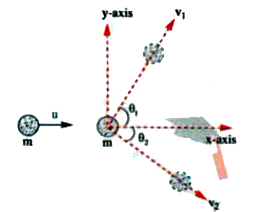
In elastic collision momentum is conserved, So, conservation of momentum along x-axis yields `m u = m v _(1) cos theta _(1) + m v _(2) cos theta_(2) , i.e., u = v _(1) cos theta_(1) + v _(2) cos theta _(2)….(1)`
and along y-axis yields, `0 = v _(1) sin thea _(1) - v _(2) sin theta _(2) ....(2)`
Squaring and adding Eqns. (1) and (2), we get
`u^(2) = v _(1) ^(2) + v _(2) ^(2) + 2 v _(1) v _(2) cos (theta _(1) + theta _(2)).....(3)`
As the collision is elastic `1/2 m u ^(2) = 1/2 mv _(1) + 1/2 mv _(2) ^(2)`
`i.e., u ^(2) = v _(1) ^(2) + v _(2) ^(2) ....(4)`
In the light of Eqn. (4), (3) reduces to
`2 v _(1) v _(2) cos (theta _(1) + theta_(2)) = 0`
As it is given that `v _(1) ne 0 and v _(2) ne 0`
so ` cos (theta _(1) + theta_(2)) =0 implies (theta_(1) + theta_(2)) = 90^(@)`

Method -II:
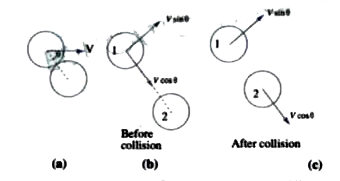
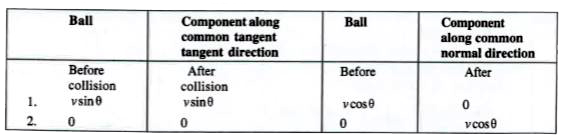
In head on elastic collision between two particles, they exchange their velocities. In thsi case, the component of ball 1 along common normal direction, `v cos theta`

becomes zero after collision, wheile that of 2 becomes v `cos theta.` While the components along common tangent directio of particles remain unchanged. Thus, the components along common tangent and common normal direction of both the balls in tabular form are given below.

From the above table and figure, we see that both the balls move at right angles after collision with velocities ` v sin theta and v cos theta.`
Promotional Banner

Topper's Solved these Questions

  • COLLISIONS

    AAKASH SERIES|Exercise VERY SHORT ANSWER TYPE QUESTIONS|12 Videos
  • COLLISIONS

    AAKASH SERIES|Exercise NUMERICAL EXERCISE ( LEVEL 1)|18 Videos
  • CENTRE OF MASS

    AAKASH SERIES|Exercise ADDITIONAL PRACTICE EXERCISE (PRACTICE SHEET (ADVANCED))|3 Videos
  • ELASTICITY

    AAKASH SERIES|Exercise Questions for Descriptive Answers|10 Videos

Similar Questions

Explore conceptually related problems

(Fill in the blank) Two right angles always_____to each other.

Show that two equal masses undergo oblique elastic collision will move at right angles after collision , if the second body initialyy at rest .

A particle of mass m moving with velocity u collides elastically with a particle of mass 3m at rest. After collision the heavier particle moves with velocity.

Show that in the case of one dimensional elastic collision , the relative velocity of approach of two colloding bodies before collision is equal to the relative velocity of separation after collosion .