Home
Class 11
PHYSICS
Two particles A and B of equal mass m ea...

Two particles A and B of equal mass m each are attached by a string of length 21 and initally placed over a smooth horizontal table in the position shown in figure Particle B is projected across the table with speed u perpendicular to AB as shown in figure. Find the velocities of the particles after the string becomes taut and the magnitude of the impulsive tension.

Text Solution

Verified by Experts
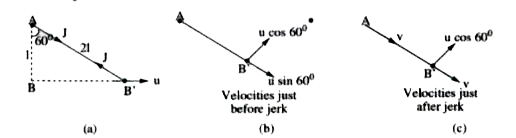
When the string beomes taut , both particles move with equal velocity component v in the directon AB.. Perpendicular to AB. there is no impulse on either particle, velocity components in this direction are therefore unchanged.

Using conservation of momentum in the direction `AB.. 0 + m u sin 60^(@) = mv + mv`
(or) `v = (sqrt3)/(4) u` therefore, just after the jerk
(i) Velocity of mass `A = (sqrt3)/(4) u` along AB.
(ii) Velocity of mass `B = sqrt (( u cos 60 ^(@) ) ^(2) + (( sqrt3)/( 4) u )^(2)) = (sqrt7)/(4) u`
in a direction inclined to AB. at an ange `tan ^(-1) (( u cos 60 ^(@) )/(v)) , i.e., at tan ^(-1) ((2)/(sqrt3)) `
The magnitude of impulsive tension (J) can be calculated by considering the change of in momentum of one of the particles.
For the mass A, in the direction `AB. , J = mv - 0 (or) J = (sqrt3)/(4) m u`
Promotional Banner

Topper's Solved these Questions

  • COLLISIONS

    AAKASH SERIES|Exercise VERY SHORT ANSWER TYPE QUESTIONS|12 Videos
  • COLLISIONS

    AAKASH SERIES|Exercise NUMERICAL EXERCISE ( LEVEL 1)|18 Videos
  • CENTRE OF MASS

    AAKASH SERIES|Exercise ADDITIONAL PRACTICE EXERCISE (PRACTICE SHEET (ADVANCED))|3 Videos
  • ELASTICITY

    AAKASH SERIES|Exercise Questions for Descriptive Answers|10 Videos

Similar Questions

Explore conceptually related problems

Two charged particles having charge 2.0 xx 10^(-8)C . Each are joined by an isolating string of length 1m and the system is kept on a smooth horizontal task. The tension in the string.

A particle of mass 'm' is attached to one end of a string of length 'l' while the other end is fixed to a point 'h' above the horizontal table, the particle is made to revolve in a circle on the table, so as to make P revolution per sec. The maximum value of P if the particle is to be contact with the table is

One end of a string of length l is connected to a particle of mass m and the other to a small peg on a smooth horizontal table. If the particle moves in a circle with speed u the net force on the particle (directed towards the centre) is

