Home
Class 11
PHYSICS
Four particles of masses m, 2m, 3m and 4...

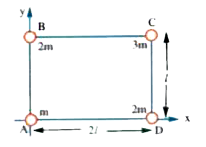
Four particles of masses m, 2m, 3m and 4m are placed at the vertices of a rectangle ABCD as shown in the figure. The particles move from A to B, B to C. C to D and D to A respectively. In this process find the displacement of centre of mass of the system.

Text Solution

Verified by Experts
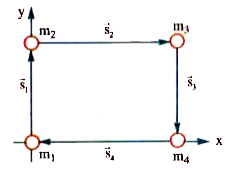
We have `vecDeltar_(CM) =(m_(1)(vec(Deltan)) + m_(2)(vec(Deltar_(2))) + m_(3)vec(Deltar_(3)) + m_(4)vec(Deltar_(4)))/(m_(1) + m_(2) + m_(3) + m_(4))`

Where `m_(1) = m, m_(2) = 2m, m_(3) =3m, m_(4)= 4m`
`vec(Deltar_(1)) = lhatj. vec(Deltar_(2)) = 2lhati.vec(Deltar_(3)) = - lhatj` and `vec(Deltar_(4)) =-2hati`
This gives :
`vec(Deltar)cm =((m)(lhatj) + 2m(2lhati) + 3m(-lhatj) + 4m(-2lhati))/(m+2m + 3m + 4m) =-(2l)/5 hati - l/5 hatj`
Promotional Banner

Similar Questions

Explore conceptually related problems

Four particles of masses 2,2,4,4 kg are arranged at the corners A,B,C,D of a square ABCD of side 2m as shown in the figure. The perpendicular distance of their centre of mass from the side AB is

Four particles P,Q,R,S of masses 1kg, 2kg, 3kg and 4kg are placed at the corners of a square of side 1m as shown below. The co-ordinates of the centre of mass of the system are

Four particles of masses 1 kg, 2 kg, 3 kg and 4 kg are placed at the four vertices A, B, C and D of the square of side 1 m. Find the position of centre of mass of the particles.

Three particles of masses 1 kg, 2 kg and 3 kg are placed at the vertices A, B and C of an equiliateral triangle ABC. If A and B lie at (0, 0) and (1, 0) m, the co - ordinates of their centre of mass are

The balls A, B and C of masses 50 g, 100 g and 150 g, respectively are placed at the vertices of an equilateral triangle. The length of each side is 1 m. If A is placed at (0, 0) and B is placed at (1, 0) m, find the coordinates (x, y) for the centre of mass of this system of the balls

