Home
Class 11
PHYSICS
Volume of the bulb of a mercury thermome...

Volume of the bulb of a mercury thermometer at `0^(@)C" is "V_(0)` and area of cross section of the capillary tube is `A_(0)`, coefficient of linear expansion of glass is `alpha_(g)` per `""^(@)C`, and the cubical expansion of mercury is `gamma_(m)` per `""^(@)C`. If the mercury fills the bulb at `0^(@)C`, find the length of mercury column in capillary tube at `T^(@)C`

Text Solution

Verified by Experts
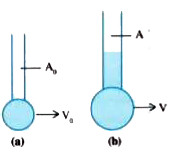
An exaggerated view of the expansion is shown figure (b).
Figure (a) represents the initial situation . When exposed to a temperature change `Delta T,` the cross-section of the capillary, the volume of the bulb , and the volume ocupied by the mercury all change (see figures). The final voluem occcupied by the mercury is
`V _(Hg) = V _(0) (1 + beta _(Hg) Delta T)`
where `beta _(Hg)` is the coefficient of volume expansion of mercury. The new cross-section of the capillary will be `A =A_(0) (1 + 2 alpha _(g) Delta T)" "...(2)`
where `alphg _(g)` is the coefficient of linear expansion of glass. Similarly, the new volume of the bulb is
`V _(g) = V _(0) (1 + 3 alpha _(g) Delta T) " "...(3)`
(Note that , initially the colume of Hg = the volume of the bulb).
Now, the volume of mercury outside the bulb in figure (b) will be
`V _(Hg) - V _(g) = V _(0) (1+ beta _(Hg ) Delta T-1 - 3 alpha _(g) Delta T)`
`V _(Hg) - V _(g) =V _(0) (beta_(Hg ) - 3 alpha _(g)) Delta T " "...(4)`
If the length of the mercury column in figure (b) is h, then
`V _(Hg ) - V _(g) = h A =h (A _(0)) (1 + 2 alpha _(g) Delta H) " "...(5)`
where we have used (2). Equating (4) and (5)
`hA _(0) (1 + 2 alpha _(g) Delta T) = V _(0) (beta _(Hg) - 3 alpha _(g)) Delta T or h =(V _(0))/( A _(0)) ((beta _(hg) - 3 alpha _(g))/( 1 +2 alpha _(g) Delta T )) Delta T,`
since `Delta T = t ^(@)C -0^(@)C`
`h = (V _(0))/( A _(0)) ((B _(Hg) - 3 alpha _(g))/( 1 + 2 alpha _(g) t ))t `
Promotional Banner

Topper's Solved these Questions

  • EXPANSION OF LIQUIDS

    AAKASH SERIES|Exercise TEST YOUR SELF|5 Videos
  • EXPANSION OF LIQUIDS

    AAKASH SERIES|Exercise VERY SHORY ANSWER TYPE QUESTIONS|15 Videos
  • EXPANSION OF GASES

    AAKASH SERIES|Exercise QUESTIONS FOR DESCRIPTIVE ANSWERS|4 Videos
  • EXPANSION OF SOLIDS

    AAKASH SERIES|Exercise Questions for Descriptive Answers|5 Videos

Similar Questions

Explore conceptually related problems

The coefficient of linear expansion of gold is 14x 10^(-6)//^(0) C. Find the coefficient of linear expansion of Fahrenheit scale.

Volume of mercury in the bulb of a thermometer is 10^(-6)m^(3) . Area of cross section of capillary tube is 2xx10^(-7)m^(2) . If the temperature is raised by 100^(@)C , the length of mercury column is (gamma_(Hg)=18" "10^(-5)//""^(@)C)

coefficient of real expansion of mercury is 0.18xx10^(-3)//""^(@)C . If the density of mercury at 0^(@)C is 13.6 gm/c.c., its density at 573 K will be

A glass bulb of volume 250 c.c is completely filled with mercury at 20^(@)C . The temperature of the system is raised to 100^(@)C . If the coefficient of linear expansion of glass is 9xx10^(-6)//""^(@)C and coefficient of absolute expansion of mercury is 1.8xx10^(-4)//""^(@)C , the volume of mercury that overflows is nearly

Coefficient of real expansion of a liquid is 0.000182//""^(@)C . If coefficient of linear expansion of vessel is 0.000009//""^(@)C , coefficient of apparent expansion of the liquid is

