Home
Class 12
PHYSICS
An electron falls throgh a distance of ...

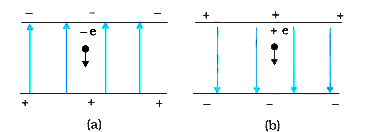
An electron falls throgh a distance of 1.5 cm in a uniform electric field of magnitude `2.0 xx10^(4) N c^(-1)` the direction of the field is reversed keeping its magnitude unchanged and a proton falls through the same distance compute the time of falls in each case contrast the situation with that of free fall under gravity

Text Solution

Verified by Experts

The field is upward so the negatively charged the magnitude of the electric of the electron is `a_(e )=eE//m_(e )`
where `m_(e )` is the mas of the electron
distance h is given by `t_(e )=sqrt(2h)/(a_(e ))=sqrt(2hm_(e ))/(e E)`
For e=`1.6 xx10^(-19) C, m_(e )=9.11 xx10^(-31)` kg
`t_(e )=2.9n xx10^(-9)` S
where `m_(p)` is the mass of the proton `m_(p)=1.67 xx10^(-27)` kg the time of fall for the proton is
`t_(p)=sqrt(2h)/(a_(p))=sqrt(2hm_(p))/(eE)=1.3 xx10^(-7)` S
`a_(p)=(eE)/(m_(p))`
`=1.9xx10^(12) ms^(-2)`
which is enormous compared to the value of g (9.8 `ms^(-2)`) the acceleration due to gravity the thus the effect of acceleration due to gravity can be ignored in this example
Promotional Banner

Similar Questions

Explore conceptually related problems

An electron of mass m , Charge e falls through a distance h meter in a unfirom electric field E. Then time of fall

An electric dipole with dipole moment 4xx10^(-9) cm is aligned at 30^(@) with the direction of a uniform electric field of magnitude 5xx10^(4)NC^(-1) . Calculate the magnitude of the torque acting on the dipole.

Consider a uniform electric field vecE=3xx10^(3)hatiNC^(-1) a. Whate is the flux of this field through a square of 0.1 m on a side whose plane is parallel to the y-z plane? b. What is the flux through the same square if the normal to its plane makes a 60 angle with x-axis?

An alpha particle of mass 6.4xx10^(-27) kg and charge 3.2xx10^(-19)C is situated in a uniform electric field of 1.6xx10^(5)Vm^(-1) . The velocity of the particle at the ennd of 2xx10^(-2)m path when it starts from rest is

A beam of electrons passes through crossed electric and magnetic fields E = 7.2 xx 10^6 NC^-1 and B = 2.4 T . If the beam goes undeviated, the velocity of electrons is

A magnetic field set up using Helmholtz coils (described in Exercise 4.16) is uniform in a small region and has a magnitude of 0.75 T. In the same region, a uniform electrostatic field is maintained in a direction normal to the common axis of the coils. A narrow beam of (single species) charged particles all accelerated through 15 kV enters this region in a direction perpendicular to both the axis of the coils and the electrostatic field. If the beam remains undeflected when the electrostatic field is 9.0 × 10^(5 )V m^(-1) , make a simple guess as to what the beam contains. Why is the answer not unique?

A short bar magnet has a magnetic moment of 0.48 JT^(-1) . Give the direction and magnitude of the magnetic field produced by the magnet at a distance of 10 cm from the centre of the magnet on (a) the axis, (b) the equatorial lines (normal bisector) of the magnet.

A circular coil of radius 8.0 cm and 20 turns, is rotated about its vertical diameter with an angular speed of 50 rad s^(-1) in a uniform horizontal magnetic field of magnitude 3.0xx10^(-2)T . Obtain the maximum and average emf induced in the coil. If the coil forms a closed loop of resistance 10 Omega , calculate the maximum value of current in the coil. Calculate the average loss due to joule heating . Where does this power come from ?

In the uniform electric field of E = 1 xx 10^(4) NC^(-1) an electron is accelerated from rest . The velocity of the electron when it has travelled a distance of 2 xx 10^(-2) m is nearly … ms^(-1) ( e/m of electron = 1.8 xx 10^(11) C kg^(-1) )
