Home
Class 11
PHYSICS
The figure given below depicts two circu...

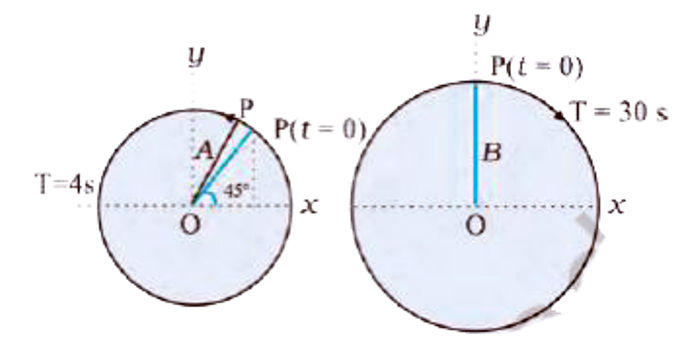
The figure given below depicts two circular motions. The radius of the circle, the period of revolution, the initial position and the sense of revolution are indicated in the figures. Obtain the simple harmonic motions of the x-projection of the radius vector of the rotating particle P in each case.

Text Solution

Verified by Experts

(a) At t = 0, OP makes an angle of `45^(@) = pi//4` rad with the (positive direction of ) x-axis. After time t, it covers an angle `(2pi)/Tt` in the anticlockwise sense, and makes an angle of `(2pi)/Tt+pi/4` with the x-axis.
The projection of OP on the x-axis at time t is given by,
`x(t)=Acos((2pi)/Tt+pi/4)`
For `T=4s`.
`x(t)=Acos((2pi)/4t+pi/4)`
which is a SHM of amplitude A, period 4 s,
and an initial phase*=`pi/4`.
(b) In this case at t = 0, OP makes an angle of `90^(@)=pi/2` with the x-axis. After a time t, it covers an angle of `(2pi)/Tt` in the clockwise sense and makes an angle of `(pi/2-(2pi)/Tt)` with the x-axis. The projection of OP on the x-axis at time t is given by
`x(t)=Bcos(pi/2-(2pi)/Tt)`
`=Bsin((2pi)/Tt)`
For T = 30 s,
`x(t)=Bsin(pi/15t)`
Writing this as x (t ) = B cos`(pi/15t-pi/2)`, and comparing with Eq. (14.4). We find that this represents a SHM of amplitude B, period 30 s, and an initial phase of `-pi/2`.
Promotional Banner

Topper's Solved these Questions

  • OSCILLATIONS

    NCERT TAMIL|Exercise Exercises|28 Videos
  • OSCILLATIONS

    NCERT TAMIL|Exercise Additional Exercises|6 Videos
  • NATURE OF PHYSICAL WORLD AND MEASUREMENT

    NCERT TAMIL|Exercise EXERCISE (V. Conceptual Questions)|5 Videos
  • PHYSICAL WORLD

    NCERT TAMIL|Exercise EXERCISES|15 Videos

Similar Questions

Explore conceptually related problems

All the surfaces shown in figure are frictionless. The mass of the car is M, that of the block is mk and the spring has spring constant. Initialy the car and the block are at rest and the spring is stretched through a length x_0 when the system is released. a. Find the amplitude of the simple harmonic motion of the blocks and of the car as seen from the road. b. Find the time periods of the two simple harmonic motions.

Plot the corresponding reference circle for each of the following simple harmonic motions. Indicate the initial (t =0) position of the particle, the radius of the circle, and the angular speed of the rotating particle. For simplicity, the sense of rotation may be fixed to be anticlockwise in every case: (x is in cm and t is in s).

A small particle travelling with a velocity v collides elastically with a spbereical body of equal masss and of radius r initially kept at rest. The centre of this spherical body is located a distnce rho(ltr) away from the direction of motion of the particle figure. Find the final velocities of the two particles.

For each natural number k, let C_k denotes the circle radius k centimeters in the counter-clockwise direction.After completing its motion on C_k , the particle moves to C_[k+1] in the radial direction. The motion of the particle continues in this manner. The particle starts at (1,0).If the particle crosses the the positive direction of the x-axis for first time on the circle C_n ,then n equal to

There are some experiment in which the outcomes cannot be identified discretely. For example, an ellipse of eccentricity 2sqrt(2)//3 is inscribed in a circle and a point within the circle is chosen at random. Now, we want to find the probability that this point lies outside the ellipse. Then, the point must lie in the shaded region shown in Figure. Let the radius of the circle be a and length of minor axis of the ellipse be 2b. Given that 1 - (b^(2))/(a^(2)) = (8)/(9) or (b^(2))/(a^(2)) = (1)/(9) Then, the area of circle serves as sample space and area of the shaded region represents the area for favorable cases. Then, required probability is p= ("Area of shaded region")/("Area of circle") =(pia^(2) - piab)/(pia^(2)) = 1 - (b)/(a) = 1 - (1)/(3) = (2)/(3) Now, answer the following questions. Two persons A and B agree to meet at a place between 5 and 6 pm. The first one to arrive waits for 20 min and then leave. If the time of their arrival be independant and at random, then the probability that A and B meet is

Two particles A and B , each carrying charge Q are held fixed with a separation D between them. A particle C having mass m and charge q is kept at the middle point of the line AB. (a) If it is displaced throught a distance x perpendicular to AB, what would be the electric force experienced by it .(b) Assuming x ltltd, show that this force is proportional to x. (c) under what conditions will the paricle C execute simple harmonic motion if it is released after such a small displacement? Find the time period of the oscillations if these conditions are satisfied.

Assume that a tunnel ils dug along a chord of the earth, at a perpendicular distance R/2 from the earth's centre where R is the radius of the earth. The wall of the tunnel is frictionless. a. Find the gravitational force exerted by the earth on a particle of mass m placed in the tunnel at a distance x from the centre of the tunnel. b. Find the component of this fore along the tunnel and perpendicular to the tunnel. c. Find the normal force exerted by the wall on the particle. d. Find the resultant force on the particle. e.Show that the motion of the particle in the tunnel is simple harmonic and find the time period.

Figure. gives the x-t plot of a particle executing one-dimensional simple harmonic motion. (You will learn about this motion in more detail in Chapter14). Give the signs of position, velocity and acceleration variables of the particle at t=0.3s, 1.2s, -1.2s .

An electric dipole formed by two particles fixed at the ends of a light rod of length l. The mass of each particle is m and the charges are -q and +q . The system is placed in such a way that the dipole axis is parallel to a uniform electric field E that exist in the region. The dipole is slightly rotated abut its centre and released. Show that for small angular displacement, the motion is angular simple harmonic and find its time period.
