Home
Class 12
PHYSICS
An electron falls through a distance of ...

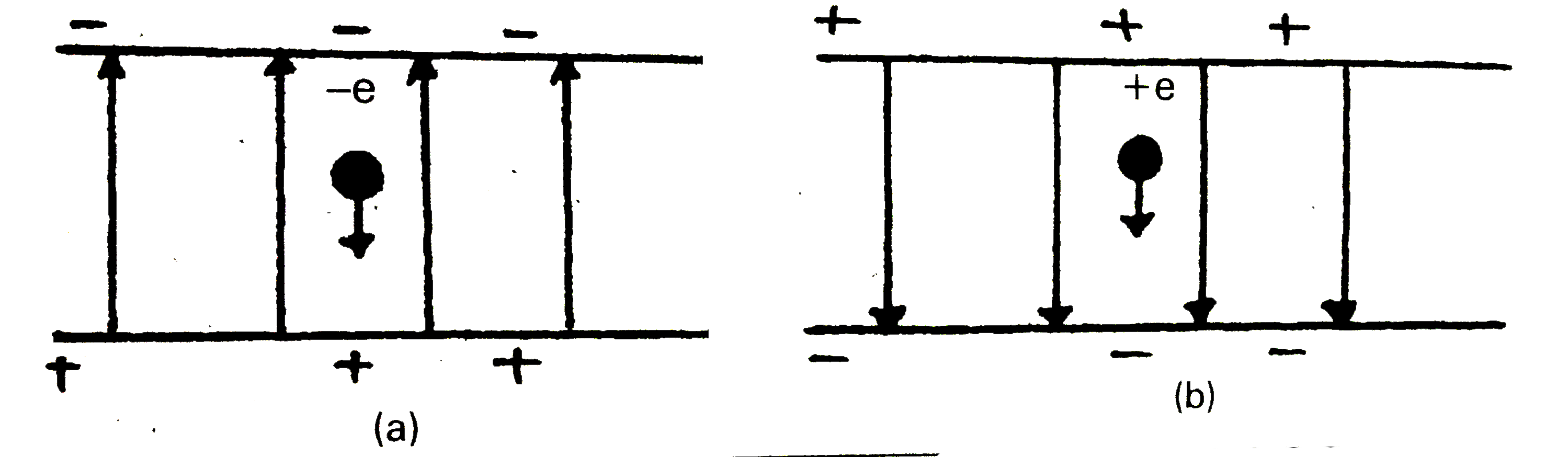
An electron falls through a distance of 1.5 cm in a uniform electric field of magnitude `2.0xx10^(4) N C^(-1)`. The direction of the field is reversed keeping its magnitude unchanged and a proton falls through the same distance. Compute the time of fall in each case. Contrast the situation with that of 'free fall under gravity'.

Text Solution

Verified by Experts

The field is upward so the negatively charged the magnitude of the electric of the electron is `a_(e )=eE//m_(e )`
where `m_(e )` is the mas of the electron
distance h is given by `t_(e )=sqrt(2h)/(a_(e ))=sqrt(2hm_(e ))/(e E)`
For e=`1.6 xx10^(-19) C, m_(e )=9.11 xx10^(-31)` kg
`t_(e )=2.9n xx10^(-9)` S
where `m_(p)` is the mass of the proton `m_(p)=1.67 xx10^(-27)` kg the time of fall for the proton is
`t_(p)=sqrt(2h)/(a_(p))=sqrt(2hm_(p))/(eE)=1.3 xx10^(-7)` S
`a_(p)=(eE)/(m_(p))`
`=1.9xx10^(12) ms^(-2)`
which is enormous compared to the value of g (9.8 `ms^(-2)`) the acceleration due to gravity the thus the effect of acceleration due to gravity can be ignored in this example
Promotional Banner

Similar Questions

Explore conceptually related problems

An electric dipole with dipole moment 4xx10^(9) Cm is aligned at 30^(@) with the direction of a uniform electric field of magnetude 5xx10^(4)NC^(-1) . Calculate the magnitude of the torque acting on the dipole.

Consider a uniform electric field E=3xx10^(3) N//C . (a) What is the flux of this field through a square of 10 cm on a side whose plane is parallel to the yz plane? (b) What is the flux through the same square if the normal to its plane makes a 60^(@) angle with the x-axis?

Consider a uniform electric field E=3xx10^(3) hat(i) N//C . A square of 10 cm on a side whose plane is parallel to the yz plane. What is the flux through the same square if the normal to its plane makes a 60^(@) angle with the x-axis?
