

Home
Class 12
PHYSICS
Suppose the spheres A and B in Exercise ...

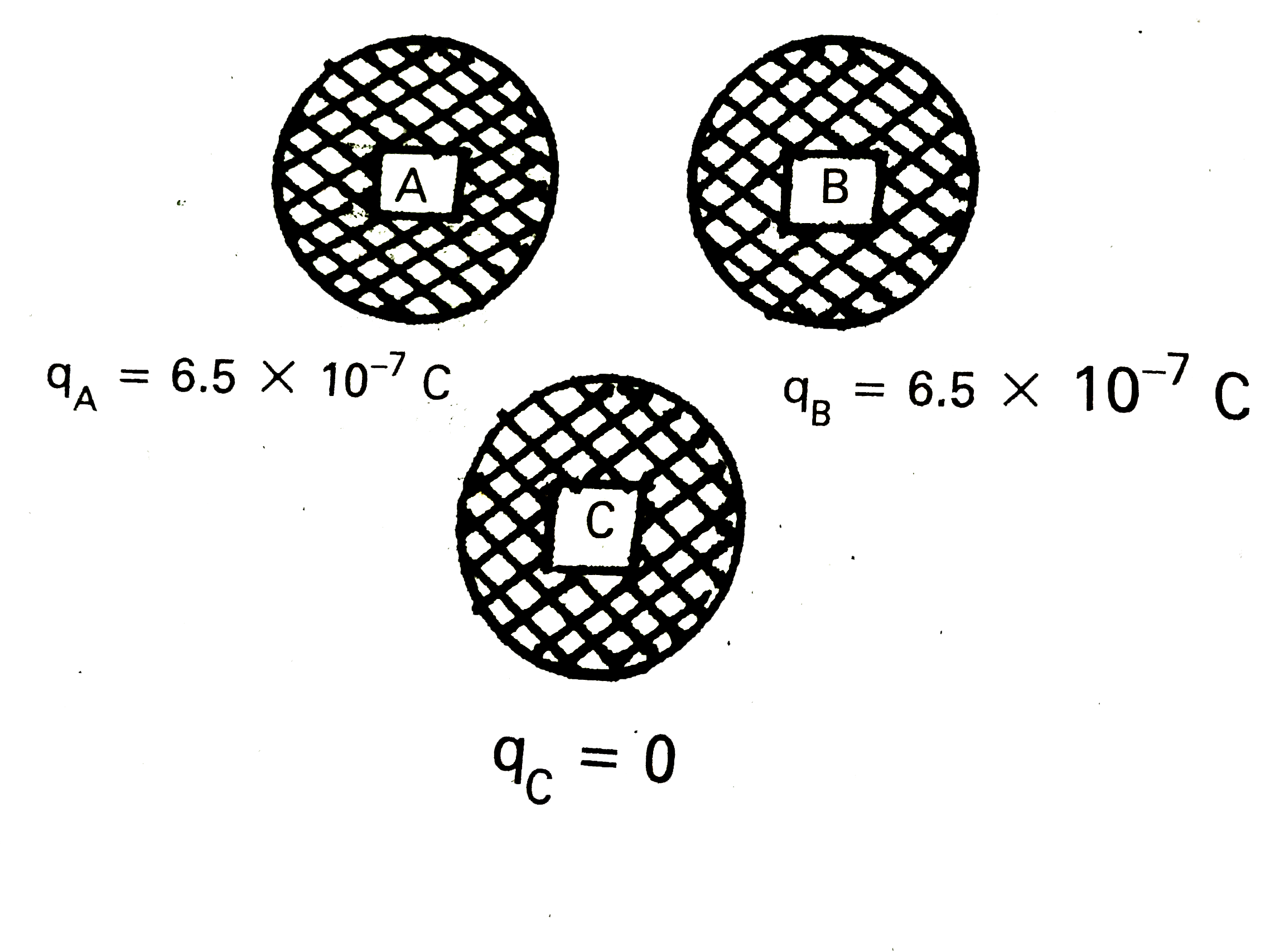
Suppose the spheres A and B in Exercise - 12 have identical sizes. A third sphere of the same size but uncharged is brought in contact with the first, then brought in contact with second and finally removed from both. What is the new force of repulsion between A and B if the distance between them is 50 cm?

Promotional Banner

Similar Questions

Explore conceptually related problems

When two identical spheres are kept in contact, the gravitational force between them is F. If two spheres of same material but with twice the radius are radius are kept in contact, then the gravitational force between them would be

Figure 6.20 shows a metal rod PQ resting on the smooth rails AB and positioned between the poles of a permanent magnet. The rails, the rod, and the magnetic field are in three mutual perpendicular directions. A galvanometer G connects the rails through a switch K. Length of the rod = 15 cm, B = 0.50 T, resistance of the closed loop containing the rod = 9.0 m Omega . Assume the field to be uniform. (a) Suppose K is open and the rod is moved with a speed of 12 cm s^(-1) in the direction shown. Give the polarity and magnitude of the induced emf. (b) Is there an excess charge built up at the ends of the rods when K is open? What if K is closed? (c) With K open and the rod moving uniformly, there is no net force on the electrons in the rod PQ even though they do experience magnetic force due to the motion of the rod. Explain. (d) What is the retarding force on the rod when K is closed? (e) How much power is required (by an external agent) to keep the rod moving at the same speed (=12 cm s^(-1) ) when K is closed? How much power is required when K is open? (f ) How much power is dissipated as heat in the closed circuit? What is the source of this power? (g) What is the induced emf in the moving rod if the magnetic field is parallel to the rails instead of being perpendicular?

A charged metalic sphere A is suspended by a nylon thread. Another charged metallic sphere B held by an insulating handle is brought close to A such that the distance between their centres is 10 cm, as shown in Fig. (a). The resulting repulsion of A is noted (for example, by shining a beam of light and measuring the deflection of its shadow on a screen). Spheres A and B are touched by uncharged spheres C and D respectively, as shown in Fig. (b). C and D are then removed and B is brought closer to A to distance of 5.0 cm between their centres, as shown in Fig. (c). what is the expected repulsion of A on the basis of Coulomb's law? Spheres A and C and spheres B and D have identical sizes. Ignore the size of A and B in comparison to the separation between their centres.

A and B are two identical point sized metal spheres each holding the same charge .q.. These two are separated by certain distance and the mutual electrostatic force between them is F. If a third identical uncharged sphere .C. is touched with A and kept exactly at the midpoint of line joining A and B, what is the resulting force on C and its direction?

Two insulated charged copper spheres A and B have their centres separated by a distance of 50 cm. What is the mutual force of electrostatic repulsion if the charge on each 6.5xx10^(-7) C ? The radii of A and B are negligible compared to the distance of separation.