

Home
Class 12
MATHS
Match the statement in Column I with the...

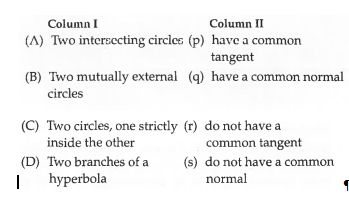
Match the statement in Column I with the properties in Column II and indicate your answer by darkening the appropriate bubbles in the `4 xx 4` matrix.

Promotional Banner

Topper's Solved these Questions

  • Some New Pattern Problems

    A DAS GUPTA|Exercise Exercise|137 Videos
  • Screening Tests

    A DAS GUPTA|Exercise Exercise|38 Videos
  • Total Conditional Probability and Bayes' Theorem

    A DAS GUPTA|Exercise Exercise|29 Videos

Similar Questions

Explore conceptually related problems

Match the statements in Column I with the properties in Column II. A

In the following [x] denotes the greatest integer less than for equal to x. Match the functions in Column I with the properties in Column II and indicate your answer by darkening the appropriate bubles in the 4 xx 4 matrix.

Column I gives certain situating in which a straight metallic wire of resitance R is used and Column II gives some resulting effects. Match the statements in Column I with the statements in Column II and indicate your answer by darkening appropriate bubbles in the 4 xx 4 matrix given in the ORS.

Two wires each carrying a steady current I are shown in four configurations in Column I. Some of the resulting effects are described in Column II. Match the statements in Column I with the statements in Column II and the indicate your answer by darkening appropriate bubbles in the 4xx4 matrix given in the ORS.

Match the integrals in Column I with the values in Column II and indicate your answer by darkening the apporpriate bubbles in the 4 xx 4 matrix.

Column I gives some devices and Column II gives some processes on which the functioning of these devices depend. Match the devices in Column I with the processes in Column II and indicate your answer by darkening appropriate bubbles in the 4 xx 4 matrix given in the ORS.

Match the complexes in column I with their properties listed in column II. Indicate your answer by darkening the appropriate bubbles of the 4xx4 matrix given in the ORS.

A DAS GUPTA-Some New Pattern Problems-Exercise
  1. Match the integrals in Column I with the values in Column II and indi...

    Text Solution

    |

  2. In the following [x] denotes the greatest integer less than for equal ...

    Text Solution

    |

  3. Match the statement in Column I with the properties in Column II and ...

    Text Solution

    |

  4. Consider the following linear equations ax+ by+cz=0, bx+ cy+az=0, cx+ ...

    Text Solution

    |

  5. Let (x,y) be such that sin-1 (ax) + cos ^-1 (y) + cos ^-1 (bxy)=pi/2...

    Text Solution

    |

  6. Let f(x) =(x^2-6x +5) / (x^2 -5x +6) Match the statement in Column I w...

    Text Solution

    |

  7. Consider the lines give by L1: x+3y -5=0, L2:3x - ky-1=0, L3: 5x +2y ...

    Text Solution

    |

  8. Consider all possible permulations of letter of the word ENDEANOEL.

    Text Solution

    |

  9. Text Solution

    |

  10. Match the statements/expressions given in Column I with the values giv...

    Text Solution

    |

  11. Match the statements/expressions given in Column I with the values giv...

    Text Solution

    |

  12. Match the statements/expressions given in Column I with the values giv...

    Text Solution

    |

  13. Match the statements/expressions given in Column I with the values giv...

    Text Solution

    |

  14. Match the statements/expressions given in Column I with the values giv...

    Text Solution

    |

  15. Let (x, y, z) be points with integer coordinates satisfying the system...

    Text Solution

    |

  16. Let A B Ca n dA B C ' be two non-congruent triangles with sides A B=4,...

    Text Solution

    |

  17. The centres of two circles C1 and C2, each of unit radius are at a dis...

    Text Solution

    |

  18. Let p(x) be a polynomial of degree 4 having extremum at x = 1,2 and l...

    Text Solution

    |

  19. The maximum value of the function f(x)=2x^(3)-15x^(2)+36x-48 on the se...

    Text Solution

    |

  20. If the function f(x)=x^(3)+e^(x//2)andg(x)=f^(-1)(x), then the value ...

    Text Solution

    |