Home
Class 10
PHYSICS
How is a normal eye able to see distinct...

How is a normal eye able to see distinctly, distant as well as nearby objects ?

Text Solution

Verified by Experts
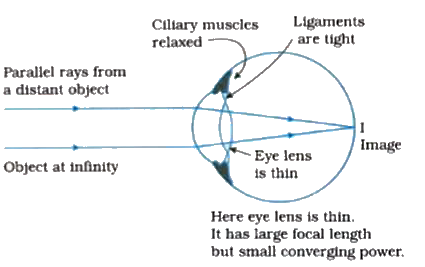
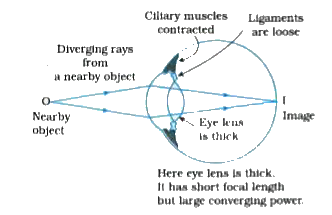
The eye lens is composed of a fibrous, jelly-like material. Its curvature can be changed (modified) to some extent by the ciliary muscles. The change in the curvature of the eye lens can thus change its focal length
The ciliary muscles are relaxed while observing distant objects such as a distant tree (at infinity). In this case, the eye lens is thin. Hence, it has maximum focal length and minimum converging power. An inverted image of the distant object is formed on the retina.
Thus, the eye is in relaxed state while observing distant objects. (It is said to be unaccommodated.)

The ciliary muscles contract while observing nearby objects (such as a book at 25 cm from the eye). In this case, the thickness of eye lens increases, radii of curvature of its surfaces decrease. Hence, the focal length of the lens decreases and converging power increases. An inverted image of the nearby object is formed on the retina.
(Thus, the eye feels uneasy while observing nearby objects. It is said to be accommodated.)
Promotional Banner

Topper's Solved these Questions

  • THE HUMAN EYE AND THE COLOURFUL WORLD

    KUMAR PRAKASHAN|Exercise TEXTUAL EXERCISE|13 Videos
  • THE HUMAN EYE AND THE COLOURFUL WORLD

    KUMAR PRAKASHAN|Exercise ADDITIONAL QUESTIONS AND ANSWERS|9 Videos
  • QUESTION PAPER-2 (MARCH,2020 - BOARD'S QUESTIONS PAPER)

    KUMAR PRAKASHAN|Exercise Section - D (Answer the following questions)|3 Videos

Similar Questions

Explore conceptually related problems

Which type of changes occur in thickness or curvature of an eye lens which enables the eye to see the distant and nearby object clearly ?

Why is a normal eye not able to see clearly the objects placed closer than 25 cm?

What should be the distance between the object in Exercise 9.24 and the magnifying glass if the virtual image of each square in the figure is to have an area of 6.25 mm^(2) . Would you be able to see the squares distinctly with your eyes very close to the magnifier?

What happens to the image-distance in the normal eye, when we increase the distance of an object from the eye?

The far point of a myopic eye is 100 cm. What is the focal length of the lens required to see very distant (normal far point) objects clearly?

For normal eye vision what is the object distance and image-distance when the object is placed at a far point? (Take the distance between the eye lens and the retina as 2.3 cm.)

For normal eye vision what is the object distance and image-distance when the object is placed at a near point? (Take the distance between the eye lens and the retina as 2.3 cm.)

A myopic adult has a far point at 0.1 m. His power of accomodation is 4 Diopters.(i) What power lenses are required to see distant objects ? (ii) What is his near point without glasses ? (iii) What is his near point with glasses ? (iii) What is his near point with glasses ? (Take the image distance from the lens of the eye to the retina to be 2 cm.)

The ciliary muscles of eye control the curvature of the lens in the eye and hence can alter the effective focal length of the system. When the muscles are fully relaxed, the focal length is maximum. When the muscles are strained, the curvature of lens increases. That means radius of curvature decreases and focal length decreases. For a clear vision, the image must be on the retina. The image distance is therefore fixed for clear vision and it equals the distance of retina from eye lens. It is about 2.5cm for a grown up person. A perosn can theoretically have clear vision of an object situated at any large distance from the eye. The smallest distance at which a person can clearly see is related to minimum possible focal length. The ciliary muscles are most strained in this position. For an average grown up person, minimum distance of the object should be around 25cm. A person suffering from eye defects uses spectacles (eye glass). The function of lens of spectacles is to form the image of the objects within the range in which the person can see clearly. The image o the spectacle lens becomes object for the eye lens and whose image is formed on the retina. The number of spectacle lens used for th eremedy of eye defect is decided by the power fo the lens required and the number of spectacle lens is equal to the numerical value of the power of lens with sign. For example, if power of the lens required is +3D (converging lens of focal length 100//3cm ), then number of lens will be +3 . For all the calculations required, you can use the lens formula and lensmaker's formula. Assume that the eye lens is equiconvex lens. Neglect the distance between the eye lens and the spectacle lens. Q. Maximum focal length of a eye lens of a normal person is

The ciliary muscles of eye control the curvature of the lens in the eye and hence can alter the effective focal length of the system. When the muscles are fully relaxed, the focal length is maximum. When the muscles are strained, the curvature of lens increases. That means radius of curvature decreases and focal length decreases. For a clear vision, the image must be on the retina. The image distance is therefore fixed for clear vision and it equals the distance of retina from eye lens. It is about 2.5cm for a grown up person. A perosn can theoretically have clear vision of an object situated at any large distance from the eye. The smallest distance at which a person can clearly see is related to minimum possible focal length. The ciliary muscles are most strained in this position. For an average grown up person, minimum distance of the object should be around 25cm. A person suffering from eye defects uses spectacles (eye glass). The function of lens of spectacles is to form the image of the objects within the range in which the person can see clearly. The image o the spectacle lens becomes object for the eye lens and whose image is formed on the retina. The number of spectacle lens used for th eremedy of eye defect is decided by the power fo the lens required and the number of spectacle lens is equal to the numerical value of the power of lens with sign. For example, if power of the lens required is +3D (converging lens of focal length 100//3cm ), then number of lens will be +3 . For all the calculations required, you can use the lens formula and lensmaker's formula. Assume that the eye lens is equiconvex lens. Neglect the distance between the eye lens and the spectacle lens. Q. Maximum focal length of a eye lens of a normal person is