Home
Class 10
PHYSICS
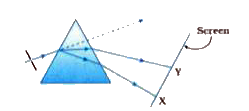
In the above figure a narrow beam of whi...


In the above figure a narrow beam of white light is shown to pass through a triangular glass prism. After passing through the prism, it produces a spectrum XY on a screen. State the colour seen at (i) X and (ii) Y.

Text Solution

Verified by Experts

The colour seen at X is violet and that seen at Y is red.
Promotional Banner

Topper's Solved these Questions

  • THE HUMAN EYE AND THE COLOURFUL WORLD

    KUMAR PRAKASHAN|Exercise Value Based Questions With Answers|24 Videos
  • THE HUMAN EYE AND THE COLOURFUL WORLD

    KUMAR PRAKASHAN|Exercise Practical Skill Based Questions with Answers|5 Videos
  • THE HUMAN EYE AND THE COLOURFUL WORLD

    KUMAR PRAKASHAN|Exercise OBJECTIVE QUESTIONS AND ANSWERS (Choose the correct option)|43 Videos
  • QUESTION PAPER-2 (MARCH,2020 - BOARD'S QUESTIONS PAPER)

    KUMAR PRAKASHAN|Exercise Section - D (Answer the following questions)|3 Videos

Similar Questions

Explore conceptually related problems

State the causes of dispersion of white light as it passes through a triangular glass prism.

When a beam of white light is passed through a triangular glass prism, it gets dispersed into its component colours. Why do we get these colours ? In the given figure, the colours X and Y represent the extreme components of the spectrum. Identify X and Y.

While passing through the prism the light ray travelling from air to glass bends towards the ………..

A narrow beam PQ of white light passes through a glass prism ABC as shown in the diagram. Trace it on your answer sheet and show the path of the emergent beam as observed on the screen DE. (1) Write the name and cause of the phenomenon observed. (2) Where else in nature is this phenomenon observed ? (3) Based on this observation, state the conclusion which can be drawn about the constituents of white light.

The refractive indices of the crown glass for violet and red lights are 1.51 and 1.49 respectively and those of the flint glass are 1.77 and 1.73 respectively A prism of angle 6^(@) is made of crown glass .A beam of white light is incident at a small angle on this prism.The other thin flint glass prism is combined white the crown glass prism such that te net mean deviation is 1.5^(@) anticlockwise. (i)Determine the angle of the flint glass prism. (ii)A screen is placed normal to the emerging beam at a distance of 2m from the prism combination.find the distance between red and violet spot on the screen Which is the topmost colour on screen.

Two beams of red and violet colours are made to pass separately through a prism (angle of the prism is 60degree ). In the position of minimum deviation, the angle of refraction will be

A glass prism of angle A = 60^(@) gives minimum angle of deviation theta ~~ 30^(@) with the maximum error of 1^(@) when a beam of parallel light passed through the prism during an experiment. Find the permissible error in the measurement of refractive index mu of the material of the prism.

When white light passes through prism, which colour of light will experience minimum deviation ?

A beam of white light falling on a glass prism gets split up into seven colours marked 1 to 7 as shown in the diagram. (1) The colours at positions marked 3 and 5 are similar to the colour of the sky and the colour of gold (metal), respectively. Is the above statement made by a student correct or incorrect. Justify. (2) Which of the positions shown above correspond approximately to the colour of (a) a brinjal, (b) danger signal, (c) neel (Lll) (applied to clothes), (d) orange.

KUMAR PRAKASHAN-THE HUMAN EYE AND THE COLOURFUL WORLD-OBJECTIVE QUESTIONS AND ANSWERS (Answer the following questions in very short as directed (Miscellaneous) )
  1. The far point of a myopic eye is 100 cm. What is the focal length of t...

    Text Solution

    |

  2. The near point of a hypermetropic eye is 75 cm. What is the focal leng...

    Text Solution

    |

  3. The eye lens of human eye is a double convex lens. Agree or Disagree?

    Text Solution

    |

  4. Cone-shaped retinal cells respond to the brightness or intensity of li...

    Text Solution

    |

  5. Which property of vision is used in cinematography ?

    Text Solution

    |

  6. What is aqueous humour ?

    Text Solution

    |

  7. What is the maximum power of accommodation of a normal eye ?

    Text Solution

    |

  8. What is meant by scattering of light?

    Text Solution

    |

  9. What is the basic cause of atmospheric refraction ?

    Text Solution

    |

  10. In the above figure a narrow beam of white light is shown to pass thro...

    Text Solution

    |

  11. In the above figure, which angles are correctly marked ?

    Text Solution

    |

  12. In the above figure (ray diagram), state the angle of incidence and th...

    Text Solution

    |

  13. In the above figure (ray diagram), state angle of incidence, angle of ...

    Text Solution

    |

  14. What is the principle of the working of the human eye?

    Text Solution

    |

  15. On which factor does the colour of the scattered white light depend ?

    Text Solution

    |

  16. Give the scientific names of the following parts of the eye : (a) Ca...

    Text Solution

    |

  17. A near-sighted person has a near point 25 cm and a far point 50 cm. Ca...

    Text Solution

    |

  18. The near point of a far-sighted person is 50 cm. Can the person see ...

    Text Solution

    |

  19. How much is our horizontal field of view (a) with one eye open (b)...

    Text Solution

    |

  20. Which of the following have a wider field of view ? (a) Animals havin...

    Text Solution

    |
