Home
Class 10
PHYSICS
When a beam of white light is passed thr...

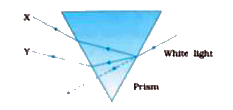
When a beam of white light is passed through a triangular glass prism, it gets dispersed into its component colours. Why do we get these colours ? In the given figure, the colours X and Y represent the extreme components of the spectrum. Identify X and Y.

Text Solution

Verified by Experts

(1) Different colours of light while passing through a prism bend through different angles with respect to the incident ray, as they travel with different speeds, this leads to dispersion of light.
(2)X-violet, Y-red
Promotional Banner

Topper's Solved these Questions

  • THE HUMAN EYE AND THE COLOURFUL WORLD

    KUMAR PRAKASHAN|Exercise Value Based Questions With Answers|24 Videos
  • QUESTION PAPER-2 (MARCH,2020 - BOARD'S QUESTIONS PAPER)

    KUMAR PRAKASHAN|Exercise Section - D (Answer the following questions)|3 Videos

Similar Questions

Explore conceptually related problems

In dispersion of white light due to a triangular glass prism, the deviation of red colour is less compared to violet colour. The reason …

In the above figure a narrow beam of white light is shown to pass through a triangular glass prism. After passing through the prism, it produces a spectrum XY on a screen. State the colour seen at (i) X and (ii) Y.

When white light passes through prism, which colour of light will experience minimum deviation ?

Why do we get different colours in the phenomenon of dispersion of white light through prism?

A beam of white light falling on a glass prism gets split up into seven colours marked 1 to 7 as shown in the diagram. (1) The colours at positions marked 3 and 5 are similar to the colour of the sky and the colour of gold (metal), respectively. Is the above statement made by a student correct or incorrect. Justify. (2) Which of the positions shown above correspond approximately to the colour of (a) a brinjal, (b) danger signal, (c) neel (Lll) (applied to clothes), (d) orange.

White light is passed through a prism of angle 5^@ . If the refractive indices for red and blue colours are 1.641 and 1.659 respectively, calculate the angle of deviation between them, also calculate the dispersive power.

Describe the activity to show that the colours of white light splitted by a glass prism can be recombined to get white light by another identical glass prism. Also draw ray diagram to show the recombination of the spectrum of white light.

An object is moving in x-y plane its velocity and acceleration at t=0 are represented in figure. The ratio of magnitude of velocity to magnitude of component of acceleration along velocity at t=0 :-

(i) A poor emitter has a large reflectivity . Explain why. (ii) A copper tumbler feels much colder than a wooden block on a cold day. Explain why. (iii) The earth would become so cold that life is not possible on it in the absence of the atmosphere. Explain why? (iv) Why clear nights are cooler than cloudy nights? Why does a piece of red glass when heated and taken out glow with green light? (vi) Why does the earth not become as hot as the sun although it has been receiving heat from the sun for ages? (vii) Animals curl into a ball when they are very cool. Why? (viii) Heat is generated continuously in an electric heater but its temperature becomes constant after some time. Explain why? (ix) A piece of paper wrapped tightly on a wooden rod is observed to get charred quickly when held over a flame as compared to a similar piece of paper when wrapped on a brass rod. Explain why? (x) Liquid in a metallic pot boils quickly whose base is made black and rough than in a pot whose base is highly polished . Why?

A physical quantity is a phyical property of a phenomenon , body, or substance , that can be quantified by measurement. The magnitude of the components of a vector are to be considered dimensionally distinct. For example , rather than an undifferentiated length unit L, we may represent length in the x direction as L_(x) , and so forth. This requirement status ultimately from the requirement that each component of a physically meaningful equation (scaler or vector) must be dimensionally consistent . As as example , suppose we wish to calculate the drift S of a swimmer crossing a river flowing with velocity V_(x) and of widht D and he is swimming in direction perpendicular to the river flow with velocity V_(y) relation to river, assuming no use of directed lengths, the quantities of interest are then V_(x),V_(y) both dimensioned as (L)/(T) , S the drift and D width of river both having dimension L. with these four quantities, we may conclude tha the equation for the drift S may be written : S prop V_(x)^(a)V_(y)^(b)D^(c) Or dimensionally L=((L)/(T))^(a+b)xx(L)^(c) from which we may deduce that a+b+c=1 and a+b=0, which leaves one of these exponents undetermined. If, however, we use directed length dimensions, then V_(x) will be dimensioned as (L_(x))/(T), V_(y) as (L_(y))/(T), S as L_(x)" and " D as L_(y) . The dimensional equation becomes : L_(x)=((L_(x))/(T))^(a) ((L_(y))/(T))^(b)(L_(y))^(c) and we may solve completely as a=1,b=-1 and c=1. The increase in deductive power gained by the use of directed length dimensions is apparent. From the concept of directed dimension what is the formula for a range (R) of a cannon ball when it is fired with vertical velocity component V_(y) and a horizontal velocity component V_(x) , assuming it is fired on a flat surface. [Range also depends upon acceleration due to gravity , g and k is numerical constant]
