Home
Class 10
PHYSICS
A narrow beam PQ of white light passes t...

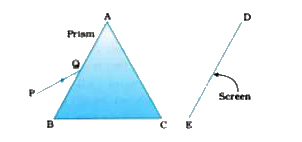
A narrow beam PQ of white light passes through a glass prism ABC as shown in the diagram.

Trace it on your answer sheet and show the path of the emergent beam as observed on the screen DE.
(1) Write the name and cause of the phenomenon observed.
(2) Where else in nature is this phenomenon observed ?
(3) Based on this observation, state the conclusion which can be drawn about the constituents of white light.

Text Solution

Verified by Experts
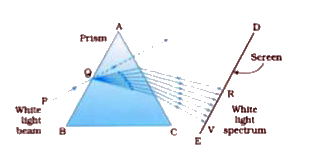

(1) The phenomenon of splitting of white light into its constituent colours is called dispersion of light. It occurs because different constituent colours of light travel with different speeds in a material medium (other than air /vacuum) and hence bend through different angles.
(2) In nature, this phenomenon is observed in formation of a rainbow.
(3) Based on the phenomenon of dispersion, we can conclude that
(a) White light consists of seven colours.
(b) Violet light suffers maximum deviation and red light suffers minimum deviation.
Promotional Banner

Topper's Solved these Questions

  • THE HUMAN EYE AND THE COLOURFUL WORLD

    KUMAR PRAKASHAN|Exercise Value Based Questions With Answers|24 Videos
  • QUESTION PAPER-2 (MARCH,2020 - BOARD'S QUESTIONS PAPER)

    KUMAR PRAKASHAN|Exercise Section - D (Answer the following questions)|3 Videos

Similar Questions

Explore conceptually related problems

Fission is observed in

The phenomenon of Tyndall’s effect is not observed in

(a) A narrow beam of white light is incident on three glass objects as shown below. Comment on the nature of the behaviour of the emergent beam in all three cases. (b) There is a similarity between two of the emergent beams. Identify the two.

State the causes of dispersion of white light as it passes through a triangular glass prism.

Observe the diagram and answer the questions: Is the seed dicot or monocot ?

Observe the diagram and answer the questions: Identify 'a' in the diagram.

In the above figure a narrow beam of white light is shown to pass through a triangular glass prism. After passing through the prism, it produces a spectrum XY on a screen. State the colour seen at (i) X and (ii) Y.

In a young's double slit experiment, green light is incident on the two slits. The interference pattern is observed on a screen. Which of the following changes would cause the observed fringes to be more closely spaced?

Where the phenomena of total internal reflection can be observed ?

The mean of n observations is bar(x) . If the first observation is increased by 1, the second by 2 and so on, the new mean is . . . .

