Home
Class 10
PHYSICS
(a) A narrow beam of white light is inci...

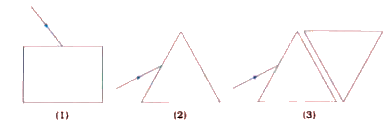
(a) A narrow beam of white light is incident on three glass objects as shown below. Comment on the nature of the behaviour of the emergent beam in all three cases.

(b) There is a similarity between two of the emergent beams. Identify the two.

Text Solution

Verified by Experts

(a) (1) The incident beam of light after refraction through the glass slab emerges parallel to the incident beam but is laterally shifted. No dispersion takes place in this case.
(2) The incident beam of light after refraction through the prism splits into a band of seven colours which are violet, indigo, blue, green, yellow, orange and red. These coloured rays emerge out of the prism along different directions and become distinct. Thus, in this case, dispersion of white light takes place.
(3) When the incident beam passes through the first prism, the prism splits it into a band of seven colours. These coloured rays are then incident on an identical inverted prism. Then the recombination of the coloured rays takes place. The emergent beam of light is parallel to the incident beam but slightly shifted outward.
(b) The emergent beam in the cases (1) and (3) are similar. In both the cases, the emergent beam is parallel to the incident beam and is laterally shifted.
Promotional Banner

Topper's Solved these Questions

  • THE HUMAN EYE AND THE COLOURFUL WORLD

    KUMAR PRAKASHAN|Exercise Value Based Questions With Answers|24 Videos
  • QUESTION PAPER-2 (MARCH,2020 - BOARD'S QUESTIONS PAPER)

    KUMAR PRAKASHAN|Exercise Section - D (Answer the following questions)|3 Videos

Similar Questions

Explore conceptually related problems

A narrow beam PQ of white light passes through a glass prism ABC as shown in the diagram. Trace it on your answer sheet and show the path of the emergent beam as observed on the screen DE. (1) Write the name and cause of the phenomenon observed. (2) Where else in nature is this phenomenon observed ? (3) Based on this observation, state the conclusion which can be drawn about the constituents of white light.

White light is incident on the interface of glass and air as shown in figure. If green ligth is just totally internally reflected then the emerging ray in air contains

A narrow beam of light is incident on a glass plate of refractive index 1.6. It makes an angle 53^@ with normal to the interface. Find the lateral shift of the beam at the point of emergence, if thickness of the plate is 30 mm. (Take sin 53^@ = 0.8.)

When a beam of white light is passed through a triangular glass prism, it gets dispersed into its component colours. Why do we get these colours ? In the given figure, the colours X and Y represent the extreme components of the spectrum. Identify X and Y.

A beam of monochromatic light is incident at i= 50^(@) on one face of an equilateral prism, the angle of emergence is 40^(@) , then the angle of minimum deviation is :

A narrow monochromatic beam of light of intensity I is incident on a galss plate as shown in figure. Another identical glass plate is kept close to the first one & parallel to it. Each glass plate reflects 25% of the light incident on it and transmits the remaining find the ratio of the minimum & the maximum intensities in the interference pattern formed by the two beams obtained after one reflection at each plate.

The refractive indices of the crown glass for violet and red lights are 1.51 and 1.49 respectively and those of the flint glass are 1.77 and 1.73 respectively A prism of angle 6^(@) is made of crown glass .A beam of white light is incident at a small angle on this prism.The other thin flint glass prism is combined white the crown glass prism such that te net mean deviation is 1.5^(@) anticlockwise. (i)Determine the angle of the flint glass prism. (ii)A screen is placed normal to the emerging beam at a distance of 2m from the prism combination.find the distance between red and violet spot on the screen Which is the topmost colour on screen.

A beam of unpolarised light of intensity is passed through a polaroid A and then through another polaroid B which is oriented so that its principal plane makes an angle of 45^(@) relative to that of A. The intensity of the emergent light

White light is incident on a glass prism as shown. Four easily identifiable colors – red, green, yellow and blue get separated as A, B, C and D. Which of the rays (A, B, C and D) correspond to which color?
