Home
Class 9
MATHS
P is a point equidistant from two lines ...

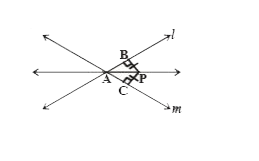
P is a point equidistant from two lines l and m intersecting at point A (see figure). Show that the line AP bisects the angle between them.

Text Solution

Verified by Experts

The correct Answer is:

`60^(@)`
Promotional Banner

Topper's Solved these Questions

  • TRIANGLES

    KUMAR PRAKASHAN|Exercise MULTIPLE CHOICE QUESTIONS|15 Videos
  • SURFACE AREAS AND VOLUMES

    KUMAR PRAKASHAN|Exercise MULTIPLE CHOICE QUESTIONS|18 Videos

Similar Questions

Explore conceptually related problems

AB is a line segment. P and Q are points on opposite sides of AB such that each of them is equidistant from the points A and B (see the given figure). Show that the line PQ is the perpendicular bisector of AB.

AB is a line - segment. P and Q are points on either side of AB such that each of them is equidistant from the points A and B (See Fig ). Show that the line PQ is the perpendicular bisector of AB.

If P(x, y) is a point equidistant from the points A(6, -1) and B(2, 3), show that x-y = 3.

A line intersecting a circle in two points is called a secant.

Two parallel lines l and m are intersected by a transversal p (see the given figure). Show that the quadrilateral formed by the bisector of interior angles is a rectangle.

AD and BC are equal perpendiculars to a line segment AB (see the given figure) Show that CD bisects AB.

PQ is a chord of length 8cm of a circle of radius 5cm . The tangents at P and Q intersect at a point T ( See figure). Find the length of TP.

If A, B and C are three points on a line, and B lies between A and C (see figure), then prove that AB + BC = AC.

I and m are two parallel lines intersected by another pair of parallel lines p and show that triangle ABC = triangle CDA

In a parallelogram OABC, vectors vec a, vec b, vec c are respectively the positions of vectors of vertices A, B, C with reference to O as origin. A point E is taken on the side BC which divide the line 2:1 internally. Also the line segment AE intersect the line bisecting the angle O internally in point P. If CP, when extended meets AB in point F. Then The position vector of point P, is
