

Home
Class 9
MATHS
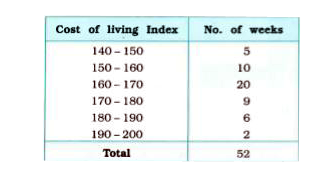
In a city, the weekly observations made ...

In a city, the weekly observations made in a study on the cost of living index are given in the following table :

Draw a frequency polygon for the data above (without constructing a histogram).

Promotional Banner

Topper's Solved these Questions

  • STATISTICS

    KUMAR PRAKASHAN|Exercise EXERCISE 14.4|6 Videos
  • STATISTICS

    KUMAR PRAKASHAN|Exercise SUM TO ENRICH REMEMBER|14 Videos
  • STATISTICS

    KUMAR PRAKASHAN|Exercise EXERCISE 14.2|9 Videos
  • QUESTION PAPER 3 : FOR THE ANNUAL EXAMINATION

    KUMAR PRAKASHAN|Exercise SECTION -D|5 Videos
  • SURFACE AREAS AND VOLUMES

    KUMAR PRAKASHAN|Exercise MULTIPLE CHOICE QUESTIONS|18 Videos

Similar Questions

Explore conceptually related problems

An insurance company selected 2000 drivers at random (i.e., without any preference of one driver over another) in a particular city to find a relationship between age and accidents. The data obtained is given in the following table: Find the probabilities of the following events for a driver chosen at random from the city: (i) The driver being in the age group 18-29 years and having exactly 3 accidents in one year. (ii) The driver being in the age group of 30-50 years and having one or more accidents in a year. (iii) Having no accidents in the year.

The length of 40 leaves of a plant are measured correct to one millimetre, and the obtained data is represented in the following table : (i) Draw a histogram to represent the given data. (ii) Is there any other suitable graphical representation for the same data ? (iii) Is it correct to conclude that the maximum number of leaves are 153 mm long? Why?

An insurance company selected 2000 drivers at random (i.e., without any preference of one driver over another) in a particular city to find a relationship between age and accidents . The data obtained are given in following table : Find the probabilities of the following events for a driver chosen at random from the city. having no accidents in one year

An insurance company selected 2000 drivers at random (i.e., without any preference of one driver over another) in a particular city to find a relationship between age and accidents . The data obtained are given in following table : Find the probabilities of the following events for a driver chosen at random from the city. being 30-50 years of age and having one or more accidents in a year.

An insurance company selected 2000 drivers at random (i.e., without any preference of one driver over another) in a particular city to find a relationship between age and accidents . The data obtained are given in following table : Find the probabilities of the following events for a driver chosen at random from the city. being 18-29 years of age and having exactly 3 accidents in one year.

A random survey of the number of childer of various age groups playing in a park was found as follows : Draw a histogram to represent the data above.

Three coins were tossed 30 times simultaneously. Each time the number of heads occurring was noted down as follows: Prepare a frequency distribution table for the data given above.

In a particular section of Class IX, 40 students were asked about the month of their birth and the following graph was prepared for the data so obtained : Observe the bar graph given above and answer the following questions: ( i ) How many students were born in the month of November? (ii) in which month were the maximum number of students born ?

Three coins are tossed 30 times simultaneously. Each time the number of heads occurring was noted down as follows: Prepare a frequency distribution table for the data given above.

The distance (in km) of 40 engineers from their residence to their place of work were found as follows : Construct a grouped frequency distribution table with class size 5 for the data given above taking the first interval as 0-5 (5 not included). What main features do you observe from this tabular representation ?