Text Solution
Verified by Experts
The correct Answer is:



Topper's Solved these Questions
COORDINATE GEOMETRY
KUMAR PRAKASHAN|Exercise Test Your Skills|23 VideosCOORDINATE GEOMETRY
KUMAR PRAKASHAN|Exercise Practice Thoroughly|15 VideosCOORDINATE GEOMETRY
KUMAR PRAKASHAN|Exercise Exercise 7 . 3|5 VideosCONSTRUCTIONS
KUMAR PRAKASHAN|Exercise OBJECTIVE QUESTIONS|25 VideosINTRODUCTION TO TRIGONOMETRY
KUMAR PRAKASHAN|Exercise Objective Questions|24 Videos
Similar Questions
Explore conceptually related problems
KUMAR PRAKASHAN-COORDINATE GEOMETRY-Exercise 7 . 4
- Determine the ratio in which the line 2x + y - 4 = 0 divides the line ...
Text Solution
|
- Find a relation between x and y if the points (x,y), (1,2) and (7,0) a...
Text Solution
|
- Find the centre of the circle passing through the points (6,-6),(3,-7...
Text Solution
|
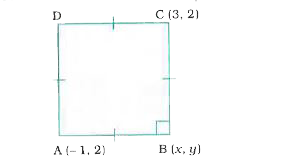
- The two opposite vertices of a square are (-1,2) and (3,2) . Find the...
Text Solution
|
- The Class X students of a secondary school in Krishinagar have been a...
Text Solution
|
- The vertices of a Delta ABC are A(4,6), B(1,5) and C(7,2) . A line is ...
Text Solution
|
- Let A(4,2), B(6,5) and C(1,4) be the vertices of Delta ABC (1) The ...
Text Solution
|
- ABCD is a rectangle formed by the points A(-1, -1) , B(-1, 4), C(5,4)...
Text Solution
|